The Church of St. Cecilia smelled like incense and centuries.
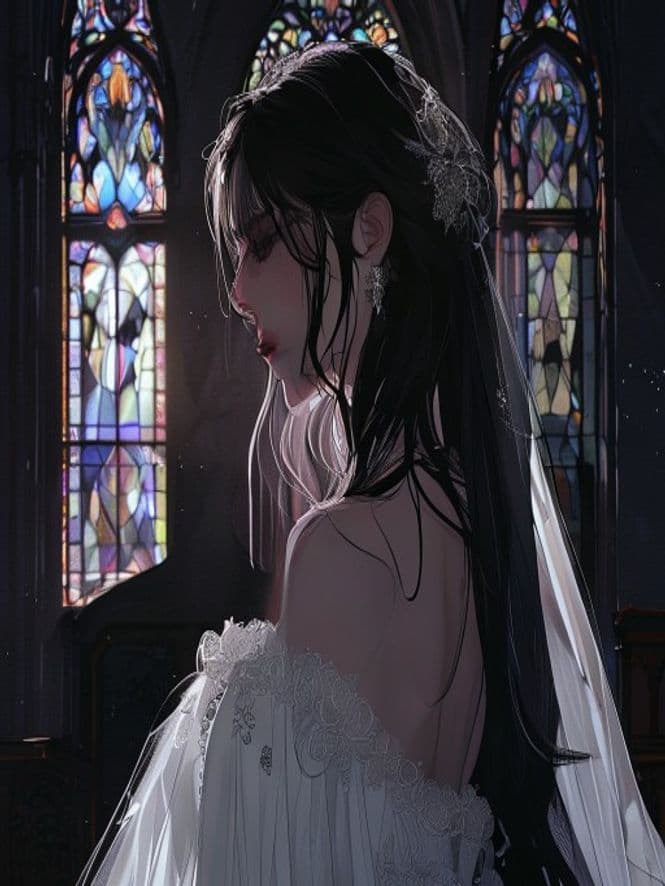
I stood in the vestibule with my father's arm through mine and counted the things I could see through the crack in the oak doors. Fourteen rows of pews, dark wood worn smooth by generations of hands. Stone columns rising into vaulted arches, the kind of architecture that was built to make humans feel small and God feel close. Stained glass along the eastern wall throwing colour onto the floor in long, bleeding panels: gold, crimson, blue, violet. The light moved when clouds shifted outside, so the saints in the glass seemed to breathe. Candles everywhere, hundreds of them, clustered on the altar and lining the aisle in glass holders that caught the flame and multiplied it.
It was beautiful. The kind of beautiful that made your chest ache if you let it.
I was not going to let it.
"Ready?" my father said.
Silver hair. Charcoal bespoke. Signet ring turning, turning, turning.
"You look beautiful," he said. He didn't meet my eyes.
"Thank you."
"Your mother would have loved this."
"My mother would have hated this. You know that."
His jaw tightened. For one breath I wanted to ask him: Did you think about Marcus? Did you think about Celia? I didn't ask. I'd stopped needing things from Victor Maren the night I found Marcus's notebook.
"Ready," I said.
The doors opened.
The organ hit first. Bach, Jesu, Joy of Man's Desiring, swelling up into the vaulted ceiling like something alive. The pews were full. Two hundred guests split down the centre aisle in a division that had everything to do with territory. Left: Maren allies, politicians, women in pastel. Right: Valentis, darker colours, harder faces.
My father walked me forward. The dress moved like water against my legs. My veil trailed on stone.
Marcus would have walked me down this aisle.
The thought arrived without permission, and I let it stay because fighting it would have shown on my face. Marcus, who believed in people. Marcus, who called me after every fight with our father and said, Tell me something real, Sera. He would have been thirty this year. He would have leaned in halfway down the aisle and whispered something irreverent, because Marcus understood that the only way to survive a performance was to acknowledge it was one.
But Marcus was dead. And the family waiting at the altar was the reason. So I carried my brother's memory like a blade beneath my ribs and kept my face as still as the stone saints in the windows.
The incense was thick enough to taste. The stained glass painted my white silk in shifting colour as I moved. Gold, then crimson, then blue. Like the church was trying to mark me.
Nico stood at the altar. Black suit. No tie. His father's watch on his left wrist.
His eyes found mine at twenty feet.
I held them. I did not look away. Not this time. I had played that weakness at the rehearsal dinner, broken first, dropped my gaze, and I'd spent the hours since cataloguing it as a mistake I would not repeat. He would see exactly what I wanted him to see: a woman walking toward him with purpose, with poise, with nothing in her chest but the cold clarity of a plan seven years in the making.
That was the version I chose to project. It was mostly true. Mostly.
Because beneath the silk and the composure and the white-knuckled grip on the bouquet, something else was happening. Something I did not sanction. His face was doing that thing it did in the hallway at the Ashford, that almost-imperceptible shift from neutral to something unguarded. His lips parted a fraction. His shoulders dropped, just barely, like a breath he'd been holding released on its own. And his eyes moved over me not the way an adversary appraises a threat but the way a man looks at a woman who has stopped him mid-thought.
I filed it. I told myself it was useful information.
My pulse was wrong. I pressed my bouquet tighter to my stomach as if pressure could correct a physiological response.
My father released my arm. I stepped up to the altar.
"You wore your hair down," Nico said.
Not you look beautiful. Not I'm glad you're here. He noticed the specific thing. The deviation from my pattern.
"Don't read into it," I said.
"I read into everything."
"I know. That's why I said it."
"Warning me?"
"Establishing terms."
The corner of his mouth shifted. "Noted."
The priest began. Father Rossi. Seventy, white-haired, kind-faced, the kind of priest who believed in the sacrament with his whole body and had no idea he was consecrating a treaty.
Luca read from Corinthians. He stood at the lectern in his navy suit, green eyes bright, and delivered the words about love being patient and kind with a voice so smooth it could have sold you anything. Love does not insist on its own way. It is not irritable or resentful. He looked at me on the word resentful. A beat too long. Then he smiled and stepped down.
Lena read the Song of Solomon. Her voice shook once, on the word beloved, and she looked at me while she read and I could see the effort it took her not to cry. I gave her the smallest nod.
The vows.
"Dominic Nicolo Valenti, do you take this woman to be your wife? To have and to hold, from this day forward, for better, for worse, for richer, for poorer, in sickness and in health, to love and to cherish, until death do you part?"
"I do," Nico said. No hesitation. No performance. Two words in that low, rough voice, spoken directly to me, not to the priest, not to the congregation.
Then Father Rossi turned to me.
"Seraphina Maren, do you take this man to be your husband?"
The church waited. Two hundred people held their breath, and the candles flickered in a draft I couldn't feel.
"I do," I said.
My voice didn't shake. I delivered the words like a contract clause, clean and precise and legally binding, because that was all they were. The verbal architecture of a deal struck in boardrooms by people who didn't care if the two humans standing in this church ever felt anything for each other.
Until death do you part. I planned for it to be the death of his empire, not mine.
The rings. Nico took my left hand.
His fingers were warm. Steady. His thumb settled against my palm, and the contact sent something electric up through my wrist, past the tattoo, into the hollow of my elbow. My pulse jumped. Not a subtle thing. A jolt, the kind that originated somewhere deeper than logic. I hated that my body responded to his touch with something that felt less like strategy and more like want. I hated that his hand was gentle when it didn't need to be. He held it the way you hold something you're being careful with, and the care was worse than any roughness would have been because it confused the narrative I'd built around him.
He slid the ring on. White gold, simple. It settled against my finger like it had always been there.
I slid his ring on without letting my fingers linger.
"You may kiss the bride."
He stepped forward. His hand came to my jaw, his thumb just below my ear, the touch so light I might have imagined it if my nerve endings hadn't been cataloguing every point of contact.
The kiss was brief. Dry. His lips touched mine for two seconds, maybe three. It was performative. We both knew it.
But his hand. His hand pressed against the small of my back as he pulled away. One second too long. Five fingertips and a palm, firm and warm through the silk, holding me in place at the exact point where my spine curved. My body catalogued it: the heat, the pressure, the way his thumb shifted against my vertebra before he dropped his hand.
Hours later, I could still feel it.
The congregation applauded. The organ surged. We turned, and two hundred people saw the Maren-Valenti alliance, sealed, signed, delivered.
I walked back down the aisle with Nico's arm through mine.
"Breathe," he said without looking at me.
"I'm breathing."
"You're not."
I breathed. He was right. The stained glass saints watched us pass, their painted faces as serene and indifferent as God.
Outside, the cold hit like a correction. Lena caught my arm on the church steps.
"You okay?"
"Perfect."
"You're lying."
"I'm a bride. It's expected."
The Ashford ballroom was a cage made of crystal.
Three chandeliers hanging from a ceiling painted to look like a Venetian sky. Gold leaf on the moulding. Marble floors polished to a mirror. Round tables draped in white, centrepieces of roses and greenery and candles in glass columns. A string quartet playing something classical that bled into the ambient noise of two hundred people drinking champagne and pretending they were happy to be here.
Four exits. Main entrance behind me. Service door near the kitchen. French doors to the terrace. Staff corridor behind the bar. Filed.
"Mrs. Valenti." A waiter appeared with champagne. The name hit me like a slap delivered with a silk glove. I took the glass.
Lena appeared at my elbow. "How are you holding up?"
"I'm fine."
"You've said I'm fine four times today. At what point do we acknowledge that's code for the opposite?"
"Five. Five is the threshold."
"Sera."
"I'm standing in a ballroom wearing a ring that belongs to a man whose family I'm going to dismantle. I'm fine."
She looked at me for a long moment. "You know what scares me? I believe you."
"Good."
"That's the scary part."
My father spoke first. Controlled, polished, brief. He talked about legacy and the strength of partnership, and he never once said the word love, and I respected the honesty of the omission even as I hated him for it.
Then Luca stood.
He took the microphone with the ease of a man who'd been performing since birth. The room laughed before he'd said a word.
"So," he said. "My brother got married." He grinned. "Some of you know Nico. You know he's not exactly the romantic type. The man runs an empire. He doesn't write love letters. He writes contracts. He doesn't send flowers. He sends NDAs."
Laughter. Warm, easy. Luca waited for it to subside.
"But I'll tell you something about my brother that most people don't know. When Nico decides something belongs to him, that's it. Done. There's no negotiation, no appeal, no exit clause. He protects what's his with everything he has." Luca's eyes drifted to me. "Everything."
The word sat in the air a beat too long.
"So, Sera." He raised his glass. His smile was wide and warm and the threat underneath was so perfectly calibrated that only someone looking for it would find it. I was looking. "Welcome to the family. We take care of our own."
We take care of our own. Two meanings, delivered simultaneously, wrapped in charm.
Lena leaned close. "Did that speech sound like a threat to you, or am I being paranoid?"
"It sounded like a best man speech."
"Sera."
"It sounded like a threat dressed up as a best man speech. Better?"
"Much. Just wanted to confirm we're living in the same reality."
The quartet shifted to something slower. Nico appeared at my side without sound. He did that. Moved through rooms like smoke.
"Dance," he said. Not a question.
His right hand settled on my waist. His left held mine at shoulder height. We stepped into the waltz and I understood immediately that Nico Valenti was a good dancer. Not the kind of good that comes from lessons. The kind that comes from awareness of another body in relation to your own, from the ability to lead without forcing. He moved, and I moved with him, and my body did the thing bodies do when they find a partner who matches their cadence: it stopped resisting.
"You're angry," he said. Low enough that only I heard it, his mouth close enough to my ear that I felt his breath displace my hair.
"I'm your wife," I said. "Same thing."
Something shifted in his face. Not a smile. Almost. The corner of his mouth moved, and for a half-second I saw something that looked like genuine amusement, the kind that surprises the person feeling it. Then it was gone and we were turning slowly under three chandeliers while the quartet played Debussy and the champagne went flat in glasses no one was drinking.
"Your brother's speech was interesting," I said.
"Luca says what he means in a way that lets him deny he meant it."
"A useful skill."
"A dangerous one."
"For who?"
"For everyone near him."
The song ended. Another began. He didn't let go, and I didn't pull away.
"You didn't step on my feet," I said.
"Low bar."
"You'd be surprised. Most men dance like they're solving a math problem."
"I'm not most men."
"I've noticed."
"People are watching," I said.
"People have been watching us all night. That's the point."
"The point is the alliance."
"Yes."
"So this is performance."
He was quiet. We turned. The music swelled.
"If it helps you to think so," he said.
"What's the alternative?"
"That I wanted to dance with my wife."
"Don't call me that."
"It's what you are."
"It's what the contract says I am. Not the same thing."
"Closer than you think," he said.
The song ended. I stepped back. He let me.
At the bar, I ordered water instead of champagne. Pellegrino over ice. I stood at the mahogany counter and pressed my thumb to the ring on my left hand and tried to remember the plan.
A woman sat three stools down. Red hair, sharp bob, pale skin, freckles. Glasses with dark frames. She wore a grey blazer over a black dress, practical, the kind of outfit that said I dressed to blend in but not to belong. She was drinking whisky, neat, and she was watching the room the way I watched rooms. Exits. Faces. Connections. The scan of someone here to observe, not celebrate.
She wasn't on the guest list. I would have remembered the hair.
Our eyes met. One second. She didn't smile. Didn't look away. Just held my gaze with calm assessment, then returned to her whisky.
I filed her. Red hair. Glasses. Watching. Something to find later.
The bartender refilled my water without being asked. "Long night?" he said.
"Long year," I said.
He had the good sense not to follow up.
Across the room, near the service corridor, my father stood in the shadow of a marble column speaking to Gianna Valenti. Their heads were close together. Not intimate. Urgent. Gianna's hand was on his forearm, gripping, and her mouth was moving fast, and my father's face was ashen. Not the controlled pallor of discomfort. The grey of a man hearing something that frightened him. His signet ring was still. Not turning. That was wrong. He always turned it. The stillness of his hands meant whatever Gianna was saying had stopped even his subconscious fidgeting.
They noticed me watching. My father's face reassembled into composure so quickly it was like watching a mask slide back into place. Gianna moved in the opposite direction.
Lena materialized beside me. "Your father looks like he just saw a ghost."
"He looks like he always looks."
"He does not. I've seen Victor Maren in boardrooms, at funerals, at your sister's memorial. He doesn't rattle. He's rattled."
"I saw."
"And?"
"And I'll deal with it."
"Tonight?"
"When I'm ready."
She looked at me, then at the spot where my father had been standing. "Be careful, Sera. Whatever that was, it wasn't small."
I added it to the file. Victor. Gianna. The fear on my father's face. I would find it.
The night wore on. I danced with Marco, who held me like a man defusing a bomb.
"Can I ask you something?" I said.
"You can ask."
"How long have you known him?"
"Since we were fifteen. He broke a guy's nose for me in a parking lot in Red Hook. I drove the getaway car. We've been inseparable since."
"That's almost sweet."
"Don't hurt him," Marco said.
"That's a strange thing to say to a bride."
"Not this bride."
We finished the song in silence.
At eleven, the ballroom thinned. The white roses were wilting.
Nico found me on the terrace. The evening air was sharp and cold against my bare shoulders. Central Park stretched below, dark and vast.
"It's time to go," he said.
"Already tired of me?"
"If I were tired of you, I'd have left you at the church."
"Romantic."
"Honest. There's a difference. Where's your coat?"
"I didn't bring one."
He looked at my bare shoulders. Looked away. "The car's warm."
"Where's the car?"
"I'm driving."
"You're driving."
"I don't let other people drive me."
"A preference or a control issue?"
"Both."
He opened the passenger door. I got in. The leather was cold, then warm where my body met it.
We drove south. Manhattan at midnight was all headlights and reflections, the wet streets catching neon. His scarred knuckles caught streetlight as we passed beneath lamps.
"You can turn on the radio," he said.
"I don't need music."
"Most people fill silence."
"Most people are uncomfortable with what silence tells them."
"And what is it telling you?"
"That we just made a very large mistake in a very old church."
"Or a very calculated decision."
"Those aren't mutually exclusive."
He almost smiled again. That fracture in the mask, there and gone.
"No," he said. "They're not."
We crossed the Brooklyn Bridge. The cables rose above us in dark lines against the sky, and the glittering Manhattan skyline receded in the rearview.
He parked on a street I didn't recognize but had memorized from satellite imagery three months ago. Four townhouses, connected in ways that weren't visible from outside.
"This is it?" I said.
"This is it."
"It looks like a neighbourhood."
"That's the idea."
Nico turned off the engine. Came around to my side. Opened my door.
He stood in the amber wash of a streetlamp, one hand on the door, his face half in shadow.
"Welcome home, Mrs. Valenti."
The words hit like a key turning in a lock. Not opening something. Closing it.
I stepped out. The brownstone loomed above us, four stories of red brick and dark windows, a wrought-iron gate leading to stone steps. Ivy climbed the facade, dead in February, its skeleton clinging to the brick like the memory of something green.
The front door was open. Warm light spilled from inside, and the smell of espresso reached me before I reached the threshold. Not the thin coffee of a machine left running. The rich, deliberate scent of espresso made by hand.
Gianna stood in the entrance hall. Five-three, silver-streaked hair still pinned, still in black, still straight-backed. She held two small cups on a tray. Her green eyes moved from her son to me and back.
It was midnight. She had left the reception, driven here, and made espresso. As if she'd known exactly when we'd arrive. As if time was a thing this family bent to its convenience.
"Come in," she said. "You'll want coffee."
I stepped across the threshold. Dark wood floors, warm light, the smell of decades of cooking embedded in the plaster walls, oil paintings in heavy frames, a staircase curving upward into shadow. Nothing like the glass and white marble I'd grown up in. Dense and warm and, against my will, not quite hostile.
Gianna handed me the espresso.
"Drink," she said. "Tomorrow is harder."
"Harder than marrying a stranger?"
"He is not a stranger anymore. That is what makes it harder."
I drank. It was perfect. Dark, bitter, no sugar.
Nico stood behind me. I could feel him without turning. The specific displacement of air that meant he was close.
"You don't have to hover," I said without turning around.
"I'm not hovering. I live here."
Gianna took the empty cup from my hands. "Your room is upstairs. Third floor. Nico will show you." She touched my face, brief, her thumb against my cheekbone. The gesture of a mother, or the assessment of a sculptor checking her material. "Sleep. If you can."
She walked deeper into the house, her footsteps fading on the dark wood floors, and I stood in the entrance hall of the Valenti compound at midnight, wearing a wedding dress and a dead man's name and a ring I planned to use as a skeleton key.
No one in this family slept. I was beginning to understand why.
What did you think of this chapter?
Drop your thoughts and get notified when new chapters arrive. The author reads every message.
Hooked? Keep reading.
You just finished the free chapters. Subscribe to unlock Chapter 4 and every chapter across all seven stories. New chapters every week.
Chapter 4: The Compound
I woke in a bed that wasn't mine, in a house that smelled like someone else's life. For three seconds I didn't know where I was. The ceiling was wrong. Too high, plaster instead of drywall, a hairline crack running from the light fixture to the far corner. The light was wrong too. Not the hard, white morning that bounced off my Upper East Side walls but something softer, filtered through curtains I hadn't chosen. Heavy linen. Cream with a...
Cancel anytime. Secure payment via Stripe.