Nam Jungsoo lived on the fourteenth floor of a Sangji District high-rise that looked like it had been designed by someone who confused money with taste. Glass and brushed steel, a lobby with marble floors and a concierge desk staffed by a woman who smiled like she was being paid by the tooth. The kind of building where people paid thirty million won a year in maintenance fees and still complained about the water pressure.
I didn't go through the lobby.
I'd spent four days building a pressure profile on Nam Jungsoo, and the picture it painted was the portrait of a man who had mistaken running for a plan. His construction company, Namsung Development, held three active permits in the Sangji redevelopment zone. His wife, a woman named Cho Eunji, taught piano at a private academy in Haeundae and drove a white Mercedes SUV she'd bought with money that had passed through four shell companies before landing in her account. His daughter was nineteen, studying abroad at a university in Melbourne whose tuition was roughly the GDP of a small fishing village. He attended a Presbyterian church on Sundays, played golf at the Haemun Country Club on Wednesdays, and on Tuesdays and Thursdays between two and five in the afternoon, he visited an apartment in Jungang-dong that was leased under the name of a woman named Shin Yuna, age twenty-six, who worked at a hostess bar in Sangji and who was not his wife.
That last detail wasn't in the file Dowan had given me. Mirae's financial records had shown a recurring monthly transfer of four million won to an account registered to a "personal services consultant." A vague enough description to be anything. But the payment dates aligned with a pattern in Jungsoo's credit card transactions: a restaurant in Jungang-dong every Tuesday, a hotel in the same neighbourhood every Thursday, both charges appearing and disappearing within a six-month window before being replaced by the lease payment. He'd moved his mistress into her own apartment. Upgraded from hotels. The progression of a man getting comfortable.
I found Yuna through the lease records Mirae had pulled. I didn't approach her. I didn't need to. What I needed was the fact of her, and the fact that Jungsoo's wife didn't know, and the fact that the police protective detail assigned to Jungsoo was monitoring his safety, not his fidelity. The fraud division cared about his testimony against the lending chain. They did not care about where he spent his Tuesday afternoons.
People always assumed debt collection was about force. About men with scarred knuckles showing up at your door and explaining the mathematics of pain. Sometimes it was. But the cleanest collections, the ones that left no trail and no bruises, were built on something quieter. Information. The gap between who a person presented themselves to be and who they actually were. Everyone had that gap. My entire existence was that gap. The trick was finding the right pressure point: the place where the gap was widest and the fear of exposure was greater than the cost of compliance.
Jungsoo's gap was a twenty-six-year-old woman in a Jungang-dong apartment, and the forty-year marriage that would detonate if her name surfaced in the fraud investigation testimony he was currently volunteering.
On the fifth day, I found him.
Not at the Sangji high-rise. Not at the apartment in Jungang-dong. I found him at a coffee shop three blocks from the courthouse where he'd been giving his deposition, a sleek glass-fronted place with too many plants and a barista who took his work personally. Jungsoo was sitting at a corner table with a paper cup he hadn't touched, staring out the window at the street where his police escort, two plainclothes detectives in a silver Kia, were parked at the kerb and looking spectacularly bored.
I ordered an Americano. Sat at the table beside his. Opened a newspaper I'd bought from the stand outside.
"Mr. Nam."
He looked at me the way people look at strangers who know their name: with the careful, calibrated fear of a man calculating how many steps it was to the door.
"Who are you?"
"Nobody important. I'm going to talk for about ninety seconds, and then I'm going to leave, and you're going to finish your coffee and go home and think about what I've said. That's all."
His hand moved toward his phone. I shook my head once, the smallest motion.
"The detectives outside are watching the entrance and the south window. We're at the north wall. They can't see us, and this conversation isn't happening. If you call them over, I'll leave before they reach the door, and the next conversation will be less polite. I am the polite version, Mr. Nam. You don't want the other version."
He stopped reaching for the phone. His face had gone the colour of wet cement.
"Two hundred million won," I said. "You know who it belongs to. The fraud division thinks you borrowed from the intermediaries. You and I both know the chain doesn't stop there. You're giving testimony about the middle of a ladder while pretending the top and bottom don't exist."
"I don't know what you're talking about."
"Jungang-dong. Apartment 14-03. Lease registered to Shin Yuna."
The cement colour drained into something closer to ash. His mouth opened. Nothing came out.
"Your wife is Cho Eunji. Teaches piano. Drives a white Mercedes, license plate Gyeonggi 48-7702. Your daughter is studying in Melbourne on money that Mrs. Cho believes came from the Namsung pension fund. It didn't. It came from the same source as the two hundred million, and if Mrs. Cho's lawyers get involved in a divorce proceeding, the discovery process will make the fraud division's investigation look like a children's game."
"You can't..."
"I'm not threatening you. I'm describing a sequence of events that will occur if the two hundred million isn't returned within seventy-two hours. Not to us. To the intermediary account you originally drew from. The same one you reported to the police. You'll simply... settle your balance. The police will see a debtor honouring his obligation. No Syndicate connection. No trail. And the information about Jungang-dong stays exactly where it is now, which is nowhere."
He was breathing through his mouth. Short, shallow pulls of air that fogged the window beside him in uneven patches. The coffee sat untouched. The newspaper in my hands was open to the business section, and to anyone glancing over, we were two men sitting at adjacent tables, one reading, one staring at nothing.
"Seventy-two hours," I said. "The account number is written on the napkin under your cup. I put it there before you sat down."
His eyes dropped to the cup. His hand trembled as he lifted it. The napkin was there, folded once, with a string of numbers in blue ink that I'd written in a hand nothing like my own.
I stood. Folded the newspaper. Left the Americano on the table with enough cash to cover it and a tip that the barista would remember as generous and the face behind it as forgettable.
At the door, I didn't look back. The detectives in the silver Kia were watching the entrance now, and I turned right, away from their sightline, and walked two blocks north before cutting through a department store and exiting on the opposite street. I caught the 302 bus back to Hagu-dong and sat in the rear seat and watched Sangji's glass towers shrink in the window until they were replaced by the low, stained concrete of the docklands, and the buildings got shorter, and the sky got closer, and I was home.
The whole thing had taken eleven minutes.
Dowan was in his office when I reported the next evening. Same desk, same harbour light, same orchid. The container cranes at Pier 9 were lit against the darkening sky, floodlights making them glow like the bones of something prehistoric.
I placed the folder on his desk, open to the confirmation page. A wire transfer of two hundred million won, routed through the intermediary account, timestamped fourteen hours after our coffee shop meeting. Jungsoo had needed less than a day. Fear will do that. The right kind of fear, applied to the right pressure point, and people move faster than you'd believe possible.
Dowan looked at the confirmation. Then at me. Then back at the confirmation.
"Sit down," he said.
I sat. The uncomfortable wooden chair. The harbour behind him had gone the colour of ink, and the office lights reflected in the windows, doubling the room, creating a ghost version of us floating over the water.
"Walk me through it."
I walked him through it. The cover version: Jungsoo had financial exposure through his personal life that made continued police cooperation riskier than settling his debt. I'd identified the exposure. Applied it. He'd paid.
"What kind of personal exposure?"
"An affair. The mistress is in a Jungang-dong apartment. His wife doesn't know. A divorce proceeding would open financial discovery that would unravel everything the fraud division is building, which means Jungsoo's own testimony becomes a weapon against him. He understood that."
"You found a mistress that the police protective detail missed."
"The police weren't looking for a mistress. They were looking for threats."
"And you were looking for leverage."
"I was looking for whatever would work."
He leaned back. The chair creaked. His hands rested on the arms, the chrysanthemum tattoo dark against the chrome, and his knuckles caught the light in a way that made the scar tissue look like quartz seams in stone.
"No contact with the target's family. No threats documented. No violence. No Syndicate fingerprint anywhere on the transaction."
"That was the brief."
"The brief was a test, Han. Most people fail it by being too aggressive or too slow. You did neither." He paused. The silence had texture. "You built a pressure profile. Behavioural patterns, financial cross-referencing, relationship mapping. You found leverage that required access to records most street collectors wouldn't know how to read, let alone think to request."
I kept my face still. The words were praise, but the delivery was dissection. He was taking apart my method the way a mechanic takes apart an engine, looking for parts that didn't belong.
"Mirae provided the financial records," I said. "I just read them."
"You read them like someone who's been trained to read them."
"Chungju had a library."
"Chungju's library doesn't teach intelligence tradecraft."
The word landed in the room like a stone in still water. Intelligence. Not business. Not street smarts. He'd chosen that word deliberately, and the ripples from it touched every wall.
I let two seconds pass. Then I let my mouth pull into the half-grin that Han, the collector, wore when someone came too close to something he didn't want examined. Cocky. A little mean. The face of a man who found the accusation funny because it was absurd.
"Tradecraft," I said. "That's a big word for a guy who reads credit card statements."
"It is."
He didn't smile. He didn't look away. His eyes held mine with the steady, unblinking focus of someone who had decided to see me and was no longer interested in what I was showing him. The harbour light was gone now, replaced by the cold white of the office LEDs, and in that light his face was all planes and shadows and the dimple on his left cheek was invisible, as if even his body knew this wasn't a moment for softness.
"Get up," he said. "We're going somewhere."
The car was a black Genesis sedan that smelled like leather and the ghost of Dowan's cologne, something clean and woody with a bitter edge that sat at the back of my throat. He drove. I sat in the passenger seat and didn't ask where we were going because asking would mean I cared, and Han, the collector, didn't care about destinations. He cared about getting paid.
We drove south through Hagu-dong. The streets were narrow and wet from an afternoon rain that had passed through without breaking the humidity, and the neon was on now, pink and blue and the sick yellow of a pawnshop sign that buzzed like something dying. Dowan drove the way he spoke: controlled, unhurried, with a precision that left no room for error or spontaneity. His left hand rested on the wheel, the chrysanthemum visible even in the intermittent streetlight. His right hand was on the gear shift, and I noticed the second tattoo for the first time: a thin line along his right collarbone, visible where his shirt collar fell open. Musical notation. Small enough to miss if you weren't looking. I was always looking.
He pulled over on a side street I didn't recognise. Between a shuttered dry cleaner and a building supply store with a faded awning, there was a door. Not a storefront. Just a door, wooden, with a pane of frosted glass in the upper half that glowed warm amber from inside.
No sign. No markings. The kind of place you only found if someone showed you where it was.
"Come on," Dowan said. He killed the engine and got out.
Inside, the world changed.
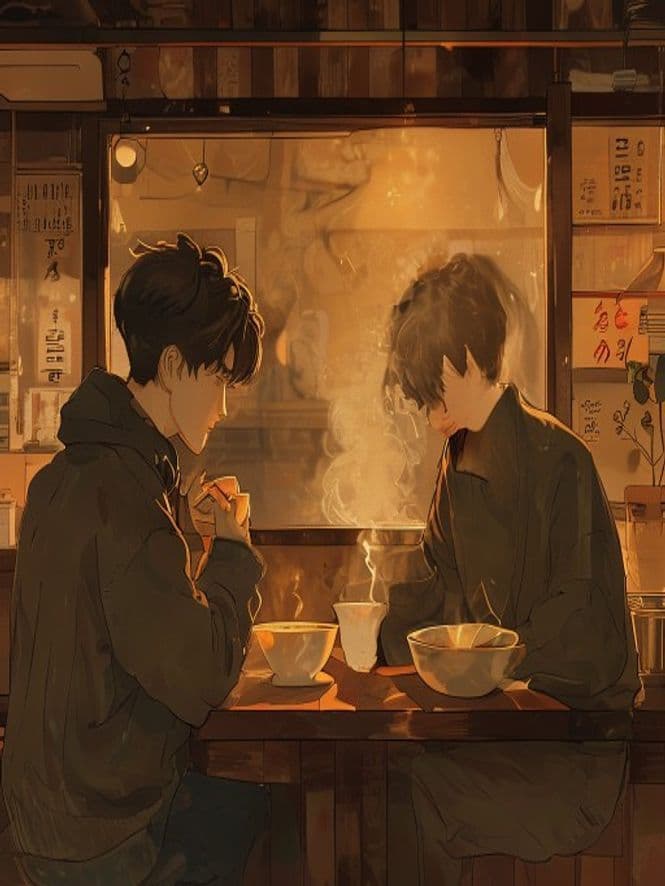
The shop was small. Eight seats at a worn wooden counter that had been polished by decades of elbows and wet bowls until the grain had darkened to the colour of honey. Behind the counter, a kitchen the size of a closet, every surface covered with something functional: jars of dried anchovies and kelp, a row of earthenware pots containing pastes and pickled things, a rack of ladles hanging from hooks, a cutting board scarred deep enough to read like a topographical map. The walls were bare except for a single calendar, three years out of date, and a photograph in a wooden frame that showed a young man standing in front of the same counter, thirty years and a full head of hair ago.
Steam. That was what hit me first. Steam rising from a pot on the stove that was large enough to bathe a child in, and in it, broth. The smell of that broth filled the entire space and pushed out everything else: the damp of the streets, the leather of Dowan's car, the tight, controlled atmosphere of The House. It replaced all of it with something so specific and so deeply buried in my memory that my hands went still on the counter before I'd even registered sitting down.
Pork bone. Dried anchovies. Dashima. Green onion, cut thick, not thin. A depth of garlic that meant whole cloves had been simmered for hours, not minced and tossed in at the end. And underneath all of it, the barest trace of doenjang, not enough to taste but enough to give the broth a low, earthy gravity that anchored everything above it.
My grandmother's ramyeon. Not the recipe. The philosophy. The understanding that broth was not a step in cooking but the point of it, that the noodles were a vehicle and the toppings were decoration but the broth was the conversation between the cook and the person being fed, and if you rushed it, you were saying something you didn't mean.
"Wan-ah."
The voice came from the kitchen, and the man it belonged to emerged from behind the steam like something developing in a photograph. Old Man Jung. Sixty-seven, according to the universe bible of Hagu-dong gossip. Small, stooped, with a face that had been weathered past age into the kind of permanence that mountains have. His hair was white and thin, combed back from a forehead creased with deep lines that all pointed upward, as though his face had spent more years smiling than frowning and the architecture reflected it. He wore a stained apron over a thermal shirt, and his hands were red from hot water and steady as stone.
"Two?" Jung asked, looking at me and then at Dowan with an expression that contained no surprise. As if strange men at his counter were as expected as the steam from his pot.
"Two," Dowan said.
Jung nodded and turned back to the stove. No menus. No questions about preferences or allergies or spice levels. Two bowls. That was the entire transaction.
I watched him work. He moved in the small kitchen with an economy that came from forty years of the same choreography: noodles dropped into rolling water, broth ladled from the big pot into two mismatched ceramic bowls, one blue, one brown with a chip on the rim. A handful of chopped green onion. A soft-boiled egg, split with a knife so the yolk ran slow and golden. Sliced mushrooms. A single sheet of gim laid across the top, already curling from the heat.
He placed the blue bowl in front of Dowan and the brown one in front of me. The broth was the colour of clouded amber, and the steam that rose from it carried everything I'd been holding at arm's length for twenty-six months.
Dowan picked up his chopsticks. "Eat," he said. Not an invitation. An instruction.
I ate.
The first mouthful of broth hit my tongue and the back of my throat simultaneously, and something behind my ribs cracked open without warning or permission. It was not the taste. Or not only the taste. It was the temperature of it, the specific scalding warmth that numbed your lips and then bloomed into something gentler as it went down, and it was the weight of it, heavier than water, richer than anything made from simple ingredients had a right to be, and it was the smell, which at this distance, with the bowl inches from my face, was so close to the smell of my grandmother's kitchen in Tongyeong that for three unguarded seconds I was not in Hagu-dong, I was not Han, I was not Agent Shin Haneul, I was eight years old and sitting on a wooden stool while a woman with my mother's hands and a patience the size of the sea fed me because I was hungry and because feeding me was how she said the things she couldn't put into words.
My eyes burned.
I didn't blink. I breathed in through my nose and out through my mouth and I ate another mouthful of noodles and I did not let whatever was happening in my chest reach my face. But my hand. My left hand, the one not holding the chopsticks, had gone flat on the counter, fingers pressed hard against the worn wood, and the pressure was wrong for a man who was simply enjoying a bowl of ramyeon. It was the pressure of someone holding on.
I looked up. Jung was watching me from behind the counter with an expression I couldn't name and didn't want to. It was not curiosity. It was recognition. The look of a man who had been feeding people for forty years and knew exactly what it meant when someone gripped his counter like it was the edge of a cliff.
He said nothing. He placed a small dish of kkakdugi beside my bowl, the radish kimchi cut into rough cubes, bright red, and he did it the way my grandmother used to place things beside my plate: without comment, without expectation, as though the act of giving required nothing in return.
I ate the kkakdugi. It was perfect. Crisp, sour, the ferment sharp enough to cut through the richness of the broth and reset the palate for the next mouthful. I ate it and I kept my eyes on my bowl because the alternative was looking at Jung again, and I was not confident about what my face would do if I did.
Dowan ate beside me in silence. He ate slowly, methodically, and I noticed that he held his bowl the way you hold something you've been given many times: without ceremony, with the comfort of repetition. He belonged here. This counter, this steam, this old man who called him by a childhood name. This was not business. This was the room behind the locked door, or something adjacent to it. The place where the mask thinned.
I understood, then, what this was. A reward. I'd passed the test. I'd collected two hundred million won from a man surrounded by police without leaving a mark, and this was what success earned in Dowan's world. Not money. Not promotion. A bowl of ramyeon in a shop with no sign, served by an old man who called you by name.
But it was also a test. A different kind. The collection had shown him what I could do under pressure. The ramyeon shop was showing him what I did when the pressure dropped. When the performance wasn't necessary. When there was steam and warmth and a bowl of something made with care, and the walls I maintained might, for a moment, come down.
He was watching me. I could feel it without looking. The particular weight of his attention, which I'd first felt in his office and which I was beginning to understand was not something he turned on and off but something he aimed, like a weapon, and right now it was aimed at my hands.
My left hand. Still flat on the counter. Still pressing too hard.
I made myself relax it. Picked up the bowl with both hands and drank the broth the way Han, the collector, would drink it: appreciatively, simply, the way a man with no past and no complications enjoys a good meal. I set it down. Wiped my mouth with the back of my hand.
"That's the best ramyeon I've ever had," I said to Jung. And my voice was steady, and the words were true, and the truth of them was the most dangerous thing in the room.
Jung smiled. The lines on his face rearranged themselves into something warm and worn, like a door that had been opened ten thousand times. "You eat like someone who's been hungry for a long time," he said. "Not in the stomach. Somewhere else."
I looked at my bowl. The broth was nearly gone. The noodles were finished. The egg yolk had mixed with the last of the liquid, turning it golden, and the gim had dissolved into dark, soft fragments that clung to the sides of the ceramic.
"It reminds me of someone's cooking," I said. And I should not have said it. Han, the debt collector with no education past high school and two years in Chungju for assault, did not have a someone whose cooking made his eyes burn. He had a past made of fabricated violence and institutional food and the kind of emptiness that didn't lend itself to nostalgia. What I'd just said was a crack in the wall, and I'd handed it to Dowan for free.
"Whose?" Jung asked.
"My grandmother's." The words came out before the discipline caught them. Two words. A lifetime inside them.
Jung nodded. He took my bowl and Dowan's and carried them to the sink and began washing them with the careful attention of a man who believed that how you cleaned was as important as how you cooked. The water ran. Steam rose from the sink. The shop was quiet except for the sound of water and the low, constant simmer of the pot on the stove, which would keep going long after we left, feeding whoever came next.
Dowan placed a folded bill on the counter. Jung ignored it. Dowan left it there. This, too, had the rhythm of repetition. An argument conducted entirely in gestures, settled the same way every time: the money left, the money eventually taken, the principle maintained on both sides.
We walked out into the night. The side street was dark except for a single streetlight at the far end that turned the wet asphalt into a mirror reflecting nothing. The air was cool against my face after the warmth of the shop, and it smelled like rain and rust and the salt tang of the harbour two blocks south.
Dowan lit a cigarette. Not Raison. Something else, a brand I didn't recognise, in a black pack he pulled from his coat pocket. The lighter's flame was brief, and the first exhale of smoke drifted between us and vanished.
He didn't offer me one. He stood beside the car and smoked and looked at the street, and I stood beside him and waited, because the silence was his and he would fill it when he was ready.
"Jung's been here forty years," he said. "Same spot. Same recipe. My mother brought me when I was four. Before she left."
I said nothing. The information was a door he'd opened on purpose. I didn't walk through it. I waited on the threshold.
"He's the only person in Hagu-dong who isn't afraid of my father." He took a drag. The cherry brightened, painting his cheekbones in amber. "That makes him either brave or senile. I've never figured out which."
"Could be both."
The ghost of the dimple. There and gone. He looked at me, and the look lasted one beat longer than it should have. Two beats. Three. The streetlight was behind him, which meant his face was in shadow and mine was lit, and I was aware, with the trained precision of a man whose survival depended on reading rooms, that the balance of visibility was not in my favour. He could see me. I could not see him. And whatever he was looking for in my face, he was looking for it in the place where the ramyeon had opened something I hadn't closed fast enough.
"You're not what your file says you are, collector."
He said it lightly. The way you'd comment on the weather or the time. A throwaway observation between the last drag and the moment you drop the cigarette.
Not lightly meant. The weight of it sat in the air between us like a held breath. His eyes were still on me, dark, unreadable, and the cigarette burned down between his fingers, and the harbour wind moved through the street carrying salt and diesel and the distant sound of a ship's horn, low and long, the sound of something arriving or leaving, and I couldn't tell which.
I held his gaze. I let Han's half-grin surface, easy, unbothered, the face of a man who had nothing to hide because he had nothing worth hiding.
"Files don't say much," I said.
He dropped the cigarette. Ground it under his heel. The ember died on the wet asphalt.
"No," he said. "They don't."
He got in the car. I got in the car. He drove me back to Block 7 without another word, and when I got out, he pulled away before I reached the building's entrance, the Genesis's taillights bleeding red into the wet street until the darkness and the fog swallowed them.
I climbed four flights. Stood in my apartment in the dark. The karaoke sign across the alley was in its red phase, and the room was the colour of an open wound.
My hands were shaking.
Not fear. Not adrenaline. Something worse. The afterimage of a wooden counter under my palms and the taste of broth that a dead woman used to make me and an old man's voice saying you eat like someone who's been hungry for a long time, and the precise, annihilating weight of Dowan's attention as he watched me remember something I'd been paid to forget.
I went to the bathroom. Crouched beside the sink. Pressed my fingers against the duct tape. The phone was there. The mission was there. The architecture of my fabricated life was intact, every wall in place, every door locked.
Except one. A crack, two words wide. My grandmother's. Said in a steam-filled shop to an old man who fed strangers, in front of a man who was already looking at me too closely and who had just told me, in six words delivered like a knife wrapped in silk, that he saw the gap between who I was performing and who I was.
I pressed my forehead against the cold pipe under the sink and breathed.
You're not what your file says you are, collector.
No. I wasn't.
And the problem, the real problem, the one that no amount of tradecraft or training or twenty-six months of practice could solve, was that in Jung's shop, with the steam on my face and the broth on my tongue, I hadn't wanted to be.
What did you think of this chapter?
Drop your thoughts and get notified when new chapters arrive. The author reads every message.
Hooked? Keep reading.
You just finished the free chapters. Subscribe to unlock Chapter 4 and every chapter across all seven stories. New chapters every week.
Chapter 4: Closer
A month is long enough to learn how a man takes his coffee. Short enough to pretend that knowing doesn't mean anything. Dowan drank his black. No sugar, no cream, from a ceramic mug he kept in the bottom drawer of his desk that was chipped on the rim and didn't match anything else in the office. He filled it from the machine on the ground floor every morning at exactly seven forty-five, before anyone else arrived, and carried it...
Cancel anytime. Secure payment via Stripe.