There are things you agree to in daylight that look different at midnight.
I had agreed, standing outside the morgue in the October morning with three dead people behind me and a man who'd been in a spirit procession eating a po'boy against the wall, to work with Caspian until I changed my mind. I had said it firmly, in the voice I use when I have made a decision and will not be talked around it. And in the daylight, with the city going about itself and Yoli's number in my phone and the familiar weight of the ordinary world on all sides, it had felt like the right call. The logical extension of the evidence. Three dead. A killer that worked in Ink. Mamie's tattoos fading. The tattoo on my hand burning in its sleep.
Midnight in St. Louis Cemetery No. 1 looked at that logic with a good deal of scepticism.
We were standing at the back gate, which was not the tourist gate. The tourist gate was on Basin Street, ornate, locked after hours with the very serious locks of a place that has had to post explicit signage about not trespassing because people kept doing it anyway and breaking things. The back gate was different: smaller, set into the far corner of the cemetery's brick perimeter wall, and the lock was a thing I had never seen before. Not a padlock. Not any mechanism I could identify, a flat disc of metal in the gate's timber post with no visible keyhole, no visible seam, just the metal sitting in the wood like it had grown there.
Caspian had a key. I use the word loosely. What he produced from the inside pocket of his coat was a piece of iron worked into the shape of something between a compass rose and a geometric sigil, four inches across, the edges irregular in a way that was not accidental but was also not any lock shape I'd ever studied. He held it flat against the metal disc in the gatepost and said something.
The French Creole came out of him differently than English: the same careful voice but with a different relationship to the vowels, something older in it, the Creole of a man who had last spoken it routinely a long time ago and for whom it lived at a deeper level than choice. What he said was six words. I heard them clearly and could not have repeated them exactly. They sat in the ear the way certain musical intervals sit, too specific to be random, too structural to be decoration.
The gate opened.
"Stay close to me," he said. "Not metaphorically. Physically close. In the Veiled City, the distance at which you can navigate independently is limited. Beyond fifty feet from me you will not be able to find your way back to the living city."
"Fifty feet."
"Approximately. Each Walker is different. I would err significantly on the side of less."
"What happens if I go further than fifty feet."
A pause that was not a comfortable pause. "The Veiled City is very large and very old and it is not designed for the living. You would find your way out eventually, I believe. But eventually is not a precise interval."
I stepped through the gate.
St. Louis Cemetery No. 1 at night, in the living city, is a specific kind of quiet. The above-ground tombs stand white in whatever light reaches them, the plaster worn and patched and worn again, some of the oldest masonry in New Orleans, three hundred years of the city putting its dead above the waterline. In the dark the tombs have the quality of very old things that have been patient long enough to no longer notice they're waiting. The alley rows between them are narrow and shadow-filled and the whole compound smells of brick dust and old stone and, faintly, the magnolia trees that have been allowed to grow between certain walls.
I knew this cemetery by daylight. The tour-stop version, the inscriptions legible, the history narrated by guides with particular expertise in the theatrical pause. I did not know it by night. At night the familiar landmarks rearranged themselves slightly, the proportions shifting without changing, the way a face changes when you see it in a different light without the face itself having moved.
Then Caspian said the second phrase.
It was longer than the first. The Creole settled over the cemetery the way the smell of magnolia settles, everywhere at once, not a sound that came from one direction but from the air itself. I felt it in my chest before I heard it fully, in the sternum, a low resonance that had nothing to do with decibels.
The living city peeled back.
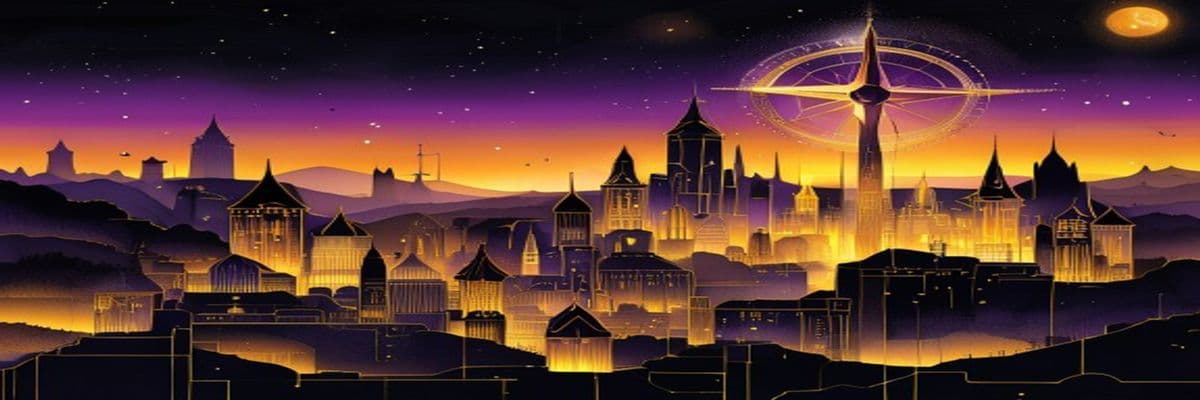
That is the only description I have for it. It did not disappear. It did not shatter or dissolve or any of the catastrophic language you might reach for. It simply stepped aside, the way a page turns, and underneath it, or behind it, or woven through it the way a descant weaves through a melody: the Veiled City.
I stood in the cemetery and the cemetery was still there and also the cemetery was not there and in its place, in the same space, was something that had the bones of St. Louis No. 1 and was not any version of it I had ever stood in.
The tombs were present. Same proportions, same above-ground architecture, same narrow alleys. But the plaster was not worn and weathered. It was whole, and it was lit from within, a warm amber glow coming from inside the stone itself rather than from any external source, as if the tombs contained a small quiet fire. Not bright. Intimate. The way a lamp lit behind thick curtains lights a room: present, warm, private. The amber was the colour of old resin, old amber, the colour of the light through the stained glass in the churches on the back streets of the Quarter when the sun hits them in late afternoon.
The sky was not the sky I knew.
I tilted my head back and looked at it and the sky above the Veiled City's cemetery was absolute black and full of stars, dense with them, every star sharp and steady in a way that stars in the living city never are, the light pollution, the haze, the particular atmospheric fuzz of New Orleans between the river vapour and the city glow all absent here, stripped away, leaving the sky as it would look from the middle of nowhere on a perfect night but more so. More stars than that, more than I'd ever seen in any sky, and arranged in constellations I did not know. Not slightly different constellations, not a matter of orientation. Unrecognisable. A sky above a city that did not correspond to any position on the earth I knew.
I would have stayed there looking at it for a long time if Caspian had not put his hand briefly on my arm.
"Don't look up for too long," he said. "Not on your first visit."
"Why."
"The sky here is not the same sky. Your eyes will try to map it and they won't be able to and that specific failure of mapping has an effect on orientation. Look at the city instead."
I brought my eyes down. The city instead.
The streets were here. Running away from the cemetery in the directions I knew: the grid of the French Quarter streets, the slight skew of the Creole architecture, the alleys between buildings. The buildings were themselves and also differently themselves: intact in the way old things are intact when they are freed from the weather and the pressure of time, the plaster without its cracks, the ironwork without its rust, the wood of the window frames without the particular silver-grey that New Orleans sun gives exposed timber. And the light from within surfaces, that amber that made everything look as though it held something warm inside, as if the city was aware of itself and the awareness produced a glow.
And there were people.
Not many. Not a crowd. But figures moving in the streets, some at the pace of people going somewhere and some at the pace of people who had nowhere particular to be and were fine with that. They did not look alarming. They wore clothes that spanned several eras, nothing that would have been strange on any given New Orleans street if you were paying the kind of attention that noticed, say, that the cut of a jacket was forty years out of date or that a woman's dress had a silhouette from the 1960s. They bought things from stalls and talked on corners and sat on the steps of the amber-lit buildings and did something that looked, with startling mundanity, like Tuesday afternoon in the Quarter. If Tuesday afternoon in the Quarter had a quieter quality of sound, the voices and footsteps muted by some quality of the air, everything present but turned down, the way you turn music down when you need to think.
"The dead?" I said.
"Some of them. And the in-between. Those who haven't finished what they started, or who prefer this side of things for reasons of their own. And various others. The Veiled City is not exclusively a place of the dead. It is a place of the city's spirit, which contains many kinds of presence."
I looked at the nearest figures, a man and a woman talking on the corner maybe thirty feet from us. Something about them was not quite right in the specific way nothing was quite wrong: a slight translucency, not enough to be dramatic, enough to notice when the amber light moved through them rather than stopped at them. They were having an ordinary conversation. The woman laughed at something the man said. The laugh was the same laugh I heard on corners in the living Quarter on any given day.
"It's not frightening," I said.
Caspian glanced at me. "No. It isn't. Most people, when they first come here, expect the frightening version." A pause. "The frightening version exists. But this isn't it."
"You've brought other people here."
"A few."
"Was it always this part first?"
"Yes." He turned and looked at me with an expression I had been trying to read since the previous night and had not fully cracked. "The city itself is not the threat. The city has been here longer than anything threatening it now. I show it first because it is important to understand what we are protecting."
We walked.
He kept us to the outer edges of the spirit streets, the less-populated alleys, close to the cemetery and moving in a contained arc. He pointed things out in the flat informational way: a building on Bourbon Street that did not exist in the living city, had not for two hundred years since it burned, but existed here intact, its original French Colonial architecture fully present, someone's lamp lit in the upper window. A stall on Royal where a woman was selling something I couldn't identify, small glass vessels of amber light, actual light, bottled. The Mississippi, glimpsed at the end of a street: there, present, but its surface absolutely still and black, no current, no chop, no tourist riverboats, just a flat surface that mirrored the unfamiliar stars with a precision that made the river look like a doorway into a sky.
I stopped looking at the river when my sense of direction went soft. Looked at the buildings instead.
The buildings were easier. I am a person who processes through looking at made things, and the Veiled City gave me made things in abundance. We moved through a short stretch of Bourbon Street, the spirit version, and the bars were there in their positions but the music coming out of them was different: not the tourist-facing stuff, not the constant stream of cover songs and party anthems that the living Bourbon pushed out onto the street, but something older, something that had the quality of music that was played because someone needed to play it rather than because an audience expected it. I heard a trumpet running a line that I didn't know and that I needed to know, the kind of line that catches you in the sternum and doesn't let go, and I almost stopped walking to find the source.
"Don't stop," Caspian said, not urgently, but with the quality of instruction.
"The music."
"Is very old. And the musician has been playing here for a hundred and fifty years and has a great deal of practice at being compelling. We have places to be."
I kept moving. But I filed the trumpet line in the part of me that files music, the deep storage, the place where things I'll need to return to live.
On a corner where Canal met something I didn't recognise, a building that had no equivalent in the living city: wide, low, Spanish Colonial facade, three storeys, the ironwork on the upper galleries painted not the usual black but a deep green that was almost black. Every window lit from within with that amber. Outside the entrance, standing without apparent purpose but positioned with the precision of someone who had been placed: a figure in grey, male-shaped, the face turned away. Not threatening. Simply present. Watching something in the middle distance.
"Marker," Caspian said, quietly.
"What does it mark."
"A convergence point. Old one. Pre-1800. The city built up around it and the point remained." He glanced at it as we walked past. "The Veiled City has these throughout. Places where the Meridian energy is concentrated in a small area. A Warden's job, in part, is to keep them stable."
"How many are there."
"In this section of the city, eleven." A pause. "Seven are currently stable. The other four have been showing signs of disturbance for six months."
Six months. There was that interval again.
"The same six months as the killings," I said.
"Yes." His voice was entirely level. "Everything connects to the same originating point. That is not coincidence. Whatever is moving through the city is deliberately targeting the convergence points, the wards, the Meridian infrastructure. The killings are part of a larger action."
"A deconstruction."
He looked at me.
"It's taking apart the city's protections," I said. "Piece by piece. The marks on the victims, the disturbance at the convergence points, Mamie's tattoos fading. It's not random. Someone is methodically removing everything that stands between the living city and whatever comes next."
The amber quiet of the Veiled City held us for a moment.
"Yes," Caspian said. "That is precisely what is happening." A pause that had something in it I hadn't heard from him before: the quality of a person who has been carrying a weight alone and has just had someone pick up the other end of it. "I have been trying to articulate that to the court for three months. They accept the evidence of the killings. They have been slower to accept the larger pattern."
"Why."
"Because the larger pattern implies a scale of attack that they would prefer not to be true." He turned and looked at me in the amber light. "It implies someone who has a specific and sophisticated understanding of how this city's protections work. From the inside."
We stood in the Veiled City's version of Bourbon Street, the music somewhere behind us, the marker figure on its corner still watching its specific middle distance, and I felt the weight of what he'd said settle.
"The Marigny," I said. "You said the murder scene was in the Veiled City version of the Marigny."
"On the other side of Esplanade. Yes." He looked in that direction. "I want to show you the mark. But we are not going tonight."
"Why."
"Because it is your first time here and you don't know the terrain. Crossing Esplanade takes us further from the cemetery exit and the Marigny section of the Veiled City has been disturbed. Whatever made the mark in the living alley has been here too, recently. The ambient quality of that part of the city is different right now. I will not take you there until you know how to navigate this side well enough to leave quickly without my help."
I wanted to argue. I held the argument in and looked at the Mississippi instead, the black mirror, the unknown stars in it.
"What does the mark look like from here," I said. "The death portrait. Can you tell me what you saw when you found it."
He was quiet for a moment. We were standing in an amber-lit alley, the buildings close on either side, the stone warm-glowing, a cat sitting on a ledge above us that was translucent enough to be a Veiled City cat but solid enough to be watching us with full feline scepticism. "The marks in the living city show a drowning," he said. "Here, on the wall of the alley in the spirit Marigny, the image is the same street. But you can see more of it. The full depth. The water is Katrina water, yes, but it is Katrina water as the city experienced it in its deepest place, the spirit memory of the flood, the way the city's own grief holds it. Whoever made those marks reached into the Veiled City's memory of that catastrophe and used it as the medium."
"To communicate something or to simply cause pain."
"Both, I think." He looked at the cat. "The city's grief is real here. The flood happened in the living city and the echo of it exists in the Veiled City as something active, something still present in the stone and the water. Using it as the ink for a murder is not only a killing. It is a desecration."
The word landed in the amber quiet.
"How do we stop it," I said.
"That is what I've been working on for three months." He looked at me. "I need someone who can work the Ink from the living side. Who can set a trap using Meridian energy in a way a Warden cannot. A Warden seals from this side. What I need is a seal that starts on the living side and closes through. A lock that turns from both ends simultaneously."
"And you think I can do that."
"Your grandmother could. She did it once before." A pause. "I need to show you how. Which requires training. Which requires time." The grey eyes. "Which we may not have."
I opened my mouth to ask what he meant by that and something stopped me. Not a sound. Not a sight. A quality of the air, a change in the amber quiet of the alley, a shift in the temperature that had no cause in anything I could identify. The cat above us, the Veiled City cat, went absolutely still, which is different from a living cat going still: total, without the micro-movements of breathing, a suspension.
Caspian had already turned.
He turned the way he moved generally, with the economy of someone for whom a response had been calibrated by long practice. He did not grab me or shout or show anything I would have read as alarm. But he was between me and the end of the alley and he was looking at something I could not see.
"What is it," I said, very quietly.
"Something noticed us." His voice was at the same volume, flat and controlled. "I cannot see it. Neither can you." A pause. "We've been made. Time to leave."
"What does that mean, we've been made."
"It means something in this section of the city is now aware we are here. Whether it is the Cartographer or something adjacent to the Cartographer I cannot determine yet. What I can tell you is that we do not stay to find out." He moved, and his hand was on my arm, guiding without gripping. "Walk. Don't look back. The cemetery is two alleys north."
We walked. I did not look back. I put my eyes on the amber-lit alley ahead and walked at a pace that was not a run and was not a stroll, the pace of people who have somewhere to be and know where it is, and I felt the thing I could not see the way you feel a change in the quality of a room, the specific awareness that the room contains more than it contained a moment ago. Not behind us. Not from a direction. Present, the way pressure is present, from everywhere at once.
The cemetery gate was where we'd left it, the back wall visible in the amber light. Caspian said the Creole phrase again, three words this time, and the Veiled City folded back the way it had opened, the living world returning in a single smooth movement like a page turning back, the amber going out, the star-dense sky dissolving into the ordinary clouded New Orleans sky with its city glow, the tombs resuming their weathered white, the stone returning to stone.
October. 3 AM. The smell of brick dust and old stone and, faintly, the river.
I was standing in the living St. Louis Cemetery No. 1 and my legs were shaking in a way I was not going to acknowledge out loud and the city around me was exactly what it always was and had been and I had just seen the thing underneath it and the shaking was appropriate and I would deal with it later.
Caspian reached into the inside pocket of his coat and produced a flask. Flat, silver, old, the surface worn dull by the same carrying that had worn the coat's buttons. He held it out.
"Drink this."
"What is it."
"Tea. Mostly. With things in it that help with the transition back." A pause. "I make it myself. I have had two centuries to refine the recipe. It will not harm you."
I took the flask and drank. It was warm, which was inexplicable given that he'd been outside in October for several hours, and it tasted of strong black tea and something darker underneath, something earthy and slightly sweet, not unpleasant, tasting of things that grew in the ground and had been growing there for a long time. By the third swallow the shaking in my legs had diminished to something I could stand on without thinking about it.
I handed the flask back. He put it in his coat.
"Okay," I said.
"The shaking is normal."
"I know it is." I pulled my jacket closer. The cemetery was dark and quiet and the tombs were the tombs and the stars were the right stars and I was in the living city and the living city felt, for the first time in my life, slightly thin. Like a wall I'd trusted because I'd never known there was a door in it. "What noticed us."
"I don't know yet. Something with enough intelligence to detect two people moving through a section of the Veiled City that is currently disturbed."
"Could it have been the Cartographer."
"Possibly. Probably something aware of the Cartographer's territory, at minimum."
I looked at the tombs. My right hand was quiet, no burning, just the familiar weight of the geometric sigil against my palm. The ink there felt darker in a way I couldn't verify in the 3 AM darkness. "We need to go back," I said. "I need to see the mark in the Marigny section. I need to see what you described, the full depth of the image."
"Yes." He was already moving toward the gate. "But not tonight."
"When."
"When I can take you in with more preparation. You need to know the basic navigation. You need the transit phrase. And I need to understand what noticed us before we go back into the disturbed section." He unlatched the gate from the inside, an ordinary mechanism on this side. The iron hinges were silent. "Two days. I'll teach you the navigation in the living city first. The transition phrase you can do."
"I can?"
He looked at me. In the 3 AM darkness, the grey eyes were grey-black, the calculated gaze doing something more than its usual calibration. "You heard me say it. You have the Ink. Both of those things are true of very few people and both of them are true of you. Yes. You can." A pause. "You'll need to practice."
I stepped through the gate onto the street outside the cemetery wall. Basin Street at 3 AM: empty, the club lights from a block over casting a faint purple into the sky, someone's car parked at the corner with the radio still going, something slow. I could hear the river without seeing it. The city breathing.
My phone buzzed.
A message. Odette Fontenot, Mamie's caretaker: Your grandmother needs to see you. She says it's the mark. She says she recognizes the hand.
I read it twice.
Caspian was already beside me, reading it over my shoulder without asking, which under other circumstances I would have addressed. Right now I let it go. "That's from Mamie's caretaker," I said.
"I see that."
"Mamie recognises the hand. The mark in the alley. Mamie has seen this work before."
"Then we go."
We drove to Treme in my car, Caspian folded into the passenger seat with his knees higher than the seat was designed for, saying nothing, watching the empty streets. New Orleans at 3 AM has a specific character: the city doesn't sleep exactly, it gets quieter, it lets the other version of itself breathe. We drove down Esplanade under the live oaks, the headlights in the tunnel of branches, the houses dark on either side, and I thought about the amber-lit version of this same road, the tombs glowing from within, the still-black river at the end of every street. Two cities. One underneath the other. And the thing that was moving through both of them, working in Ink, making its series.
The double shotgun on St. Bernard Avenue was dark except for the light above the gallery door that Odette left on through the night. The gallery was empty. Mamie's rocker was there but Mamie was not in it.
I was already halfway up the steps when I looked more carefully.
Mamie was in the rocker.
She was asleep, the blue blanket on her lap, her head resting against the wood of the high chair back. Her hands were folded in her lap. Her breathing was even, the slow rhythm of deep sleep, genuine sleep, not distress. She was simply asleep in her chair, the way old people sometimes fall asleep in their chairs, the way it looks like grace from the outside.
On the side table beside her, next to the cold coffee cup from this morning, a notepad. Mamie kept notepads everywhere, the spiral-bound drugstore kind, for lists and reminders and the occasional sharp observation. Her handwriting was the same close forward-leaning script I had known all my life.
Caspian had come up the steps behind me. He read it over my shoulder again and this time I didn't object because I had stopped being able to manage social niceties in the face of the two words on the notepad in my grandmother's handwriting.
The notepad said, in Mamie's hand: He's awake. Run.
What did you think of this chapter?
Drop your thoughts and get notified when new chapters arrive. The author reads every message.
Hooked? Keep reading.
You just finished the free chapters. Subscribe to unlock Chapter 4 and every chapter across all seven stories. New chapters every week.
Chapter 4: The Court
Mamie had no memory of writing the note. She was awake by the time we came up the gallery steps, the early morning light going amber on the iron lace, the blue blanket on her lap exactly where it had been at 3 AM when we'd stood above her sleeping form and read the notepad on the side table. She was awake and clear, the way she was clear on good days, the sharp-eyed woman who had run a tattoo...
Cancel anytime. Secure payment via Stripe.