Monday arrived with the kind of grey precision that late April in London specialises in, a flat white sky pressing down on the white stucco terrace outside my window. I lay in the dark and listened to the house wake up: the climate-control cycling to its morning settings, a soft click somewhere below, the faint sound of a kettle on the lower ground floor. Robert, already at his post. Six forty-five. I had been awake since five.
I got up, made myself useful, and tried not to think about what I was doing.
What I was doing was straightforward. I was starting a job. I had a catalogue to build: 847 works, five centuries, a mountain of acquisition files that hadn't been systematically processed in five years. I had a system in mind, a schema I'd been developing since the Tuesday of the interview, a hierarchical structure based on the Frick's model but adapted for a private collection with more cross-period connective tissue. I had three new pencils, two of the brown notebooks, and the conviction that what this archive needed was about five hundred hours of unglamorous, deeply satisfying organisational work.
That was what I was doing.
I changed into the better of my two work cardigans and went upstairs.
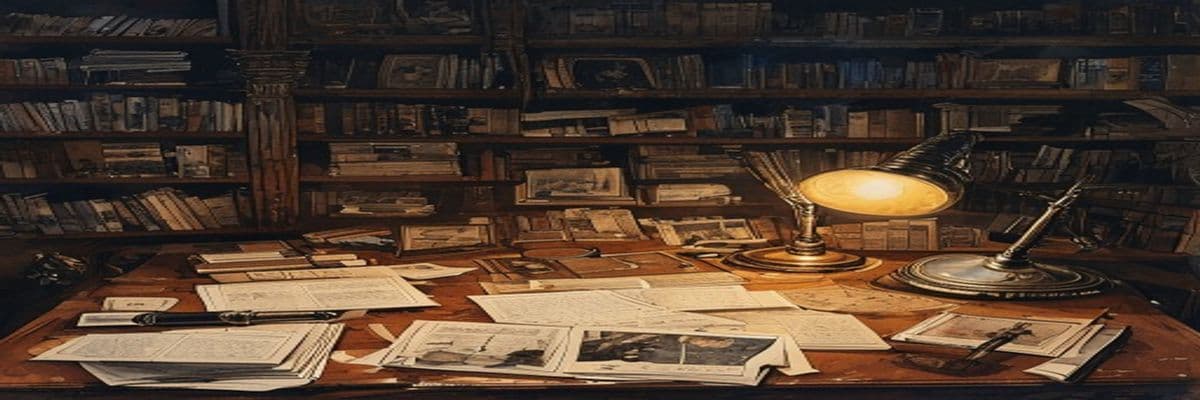
The fifth floor at seven in the morning had a quality I hadn't expected. The light from the two east-facing windows came in at a low angle and caught the dust motes over the long table, making them visible as gold specks against the paper-grey of the archive. Old paper light. I stood in the doorway for a moment and breathed it in, that mineral-and-mustiness combination, the smell of things preserved and unread. Then I put my bag on the chair at the near end of the table, opened my first notebook to the first page, uncapped a pencil, and started.
I was cataloguing the Italian section when Julian opened the archive door at half past nine.
I knew it was him from the footsteps: the unhurried, certain quality I'd learned in the interval between the interview and today. Robert's step was crisper, more rhythmic, a man who had organised his own gait into efficiency. Julian's was different. Measured, yes, but with the particular weight of someone moving through a space they own without needing to assert it.
He stopped in the doorway. I had the box labelled Italian, 16th-17th c., acquisition docs open on the table, and four folders arranged in front of me by acquisition date, and my notebook open to a half-completed entry for a Lombard altarpiece fragment.
"Miss Whitmore," he said.
"Good morning." I looked up. He was in a dark charcoal suit, no tie, white shirt, reading glasses hooked in his front breast pocket. He was holding a folder of his own and a cup of tea. "Iris, please," I said. "If we're going to be in the same building every day I'd rather not start every sentence with two syllables of formality."
He looked at me steadily for a moment. "Iris," he said. He said it the way someone tests the weight of something unfamiliar: not reluctant, but careful. Like a word in a language he was learning.
"Thank you," I said, and went back to the Lombard altarpiece.
He came in. He set his tea on the corner of the table well away from my folders, which I noted and approved of. He pulled the chair at the far end and sat down and opened his own folder. We worked in silence for a few minutes, the pencil scratch of my notes and the soft turn of his pages, and the archive settled around us.
"The Italian section," he said eventually, without looking up. "The acquisition files are split. Some are in that box, the rest are in the box marked Conservation, mixed, 2018-2022. The filing system assumed documents would be sorted by conservation status rather than acquisition period. It was, in retrospect, optimistic."
"I gathered." I had already found three Italian documents in the conservation box when I'd done an initial survey of the archive layout. "I'll cross-reference as I go. It'll take longer to build the initial schema but the final structure will be cleaner."
"How long for the initial schema?"
"Three weeks, possibly four. The schema itself is fast. The cross-referencing takes time because some of the earlier acquisition files reference pieces I haven't yet located in the physical collection." I paused. "I'd like to do a walk-through of all the gallery spaces before I go too far. So I can match what I'm reading to what I'm looking at."
"Of course," he said. "This afternoon, if you like. I'll take you through." He said it with the same evenness he brought to everything, but the offer was a practical one, and I took it as such.
"Thank you. That would help enormously."
We worked. The light shifted from east to overhead as the morning progressed. At one point Robert appeared with a second cup of tea, set it precisely at the edge of my workspace, and withdrew without comment. I noted this also.
At ten past eleven, Julian said, "The Lombard altarpiece. Have you seen the condition report?"
"I found the acquisition file. No condition report attached."
"Separate folder. Top shelf, far right, behind the box marked Unresolved, various."
I stood up, found the folder, and brought it back. It was a conservation assessment from 2019, thorough, with high-resolution photographs attached. The altarpiece had a hairline crack through the lower register that had been stabilised but not restored. The paint surface in the cracked area was excellent.
"The crack follows the original canvas support junction," I said, scanning the report. "It's stable and it's old. The paint surface isn't compromised. I'd recommend no restoration work, just continued monitoring." I looked up. "Unless you disagree."
Julian had turned in his chair. He was looking at me with an expression I was beginning to recognise: the one that meant he was paying full attention, and that full attention from Julian Ashford had a quality unlike other people's. Not intensity for its own sake. More like he had genuinely wondered about something and then found the answer.
"No," he said. "I agree. I've thought the same thing for three years but the conservator wanted to restore. The urge to fix things is understandable. Not always correct."
"Some cracks are part of the painting now," I said.
"Yes." He held my gaze for a moment. "Exactly."
The weekly review meeting was on Wednesdays at two o'clock, in Julian's study on the second floor. I prepared for it the way I'd prepared for tutorials at the Courtauld: a short typed agenda, key questions, any attribution issues I needed his input on. He had not asked for this. I did it anyway.
The study was warm and book-lined and precisely ordered, in a way that was different from the archive's generative chaos. The archive was a working mess; the study was an achieved stillness. The desk was large and dark, the kind of desk that had been in a room long enough to become part of it. One window overlooking the garden, currently grey. A Basquiat on the wall that I was pointedly not cataloguing yet because I knew the moment I started I'd be there for twenty minutes minimum and I had an agenda.
Julian sat across the desk from me and picked up my agenda before I could hand it to him, which meant he'd been looking at it. He had put his reading glasses on.
"Attribution query on the Dutch study," I said. "Second floor, south wall, currently listed as 'school of Rembrandt, circa 1650.' I've been looking at the handling of the flesh tones and the specific way the shadow falls below the jawline."
"Go on," he said.
"I think it's closer to Rembrandt himself than 'school of' implies. The transition between warm highlight and the cool mid-shadow is too controlled for a student copy. Students in Rembrandt's workshop got the shadow right and botched the transition, or got the highlight right and overcrowded the shadow. This is — the transition is alive. There's a hesitation in it, a recalibration you can see in the micro-strokes if you look at it under good magnification. That's not a student doing a clean copy. That's the source working something out in real time."
Julian set down the agenda. He looked at me for a moment.
"Two of the previous curators attributed it to school of Rembrandt without question," he said.
"They may be right." I said this carefully. "I'd want to compare it to documented Rembrandt technique from the same period before I changed the catalogue entry. And there'd need to be a provenance chain that supports the attribution. I'm not rewriting anything on instinct."
"But your instinct says."
"My instinct says look harder."
He took his reading glasses off. Set them on the desk. I had now catalogued exactly three instances of Julian Ashford taking his glasses off while talking to me, and I was doing nothing useful with this information.
"The provenance file for the Dutch study," he said. "It's in the archive, box fourteen."
I knew which box fourteen was. It was the unlabelled one on the top shelf. The one he hadn't mentioned on the day of the interview. "The box without a label?"
"Yes."
"I didn't want to presume."
"You should have presumed." He said this without censure, flat and matter-of-fact. "Presume freely. The archive is yours to work."
"Right," I said.
The rest of the agenda was standard: condition monitoring schedule, the ter Borch provenance research I'd begun, the insurance documentation that needed updating. Julian engaged precisely and practically on all of it. The meeting was supposed to run one hour. At three fifty-seven I looked at my watch and the numbers resolved into the fact that we had been talking for almost two hours.
"I'm sorry," I said. "That ran long."
"It ran well," he said. He was standing by the window, which he'd moved to at some point in the second hour, and the grey afternoon light fell across the side of his face in a way that made him look older and, more than ever, like someone a portrait painter would want to sit down. "The ter Borch research. When you say the 1942 Amsterdam gallery transfer may be a problem."
"Wartime market language. 'Private sale' between a Jewish-owned collection and an Amsterdam dealer in 1942 under occupation means I need to look harder. It may be perfectly legitimate. It may not be." I watched his face. "You said presume freely."
"I did." He turned from the window. His expression was the same one from the altarpiece conversation, the one I was starting to associate with something that wasn't quite surprise but was adjacent to it. "If the provenance is compromised, we return it. Whatever the market value. That's not a difficult principle."
"It isn't," I said. "Not everyone holds it."
"I'm aware," he said, in a tone that had an old discomfort behind it, as though the art world's less scrupulous practices had been a grievance of long standing. "Research it thoroughly. If it needs to go back, I want it documented cleanly."
I wrote it down in the notebook, even though I would have remembered it. Writing things down is a habit. A way of saying: this happened, it mattered, I was here.
Tuesday of the second week. The Dutch Golden Age section.
Julian had set aside Tuesday afternoons for the Dutch collection, which was his, and he meant it like a gardener means their best beds. He was waiting in the gallery when I arrived with my notebook, and the room was — I had to stop for a moment in the doorway because the room was different than I'd seen it in passing on the way up the stairs. At rest, in this light, with the afternoon working itself amber through the one unshuttered window, it was extraordinary.
Four Vermeer followers, one authenticated ter Borch, two de Hooch studies, three pieces of middling-to-good quality attributed to Dou, Steen, Metsu. The works hung in a chronological order that was academically correct and, as I had thought since the interview, slightly wrong for the feeling of the room. Each painting was lit by its individual directional lamp, controlled and professional. But the overall effect was of specimens, not company.
"Can I ask you something?" I said.
Julian, who had been studying the ter Borch attribution piece across the room, turned. "Yes."
"The arrangement. It's chronological."
"It is."
"It works. It's correct. But if you moved the de Hooch studies to sit between the two Vermeer followers, and brought the Metsu forward to anchor the far corner, the emotional logic of the room would shift. You'd feel the domestic intimacy as a single argument rather than a historical sequence. The light in each painting would speak to the light in the next."
He was quiet for a moment. The afternoon in the gallery was very still, the kind of quiet that has its own texture.
"Show me," he said.
"I shouldn't presume to—"
"Show me." Not unkind. Direct.
I crossed to the far wall and put my hands on the de Hooch study frame, not to move it but to indicate placement. "Here. Between the Vermeer followers instead of after them." I moved to the far corner. "The Metsu here, facing inward. So the eye travels the room and lands on domestic warmth before it exits." I looked at him. He was standing in the centre of the room, turning slowly, looking at the walls with his head slightly tilted. "It means the room tells a story about longing rather than just a story about time."
Julian looked at the walls for a long moment.
"Longing," he said.
"They all painted the same thing," I said. "Women in rooms. Men in rooms occasionally. People absorbed in something — reading, writing, pouring wine, looking out a window. Absorbed and private and lit, always lit, from an unseen source outside the frame. De Hooch patented the threshold. Vermeer patented the light. But what they're all doing is painting desire. The desire to be in that room. To have that stillness. To be the woman at the table, absorbed in something that belongs entirely to you."
The afternoon light was in the room between us, doing exactly what I was describing: falling from the half-shutter of the unblocked window onto the floor in a long warm panel. Julian stood in the middle of it. He was looking at me.
"You should rearrange the room," he said.
"I don't want to overstep. It's your collection."
"It's your eye." He paused. "They're not exclusive."
I looked at the walls. I looked at the paintings of women in rooms. I looked at Julian in his own gallery, in the afternoon light, standing in the specific posture of a man who has been alone in a beautiful space for a long time.
"All right," I said.
I rearranged the room. He stood in the centre and watched, occasionally suggesting a centimetre or two of adjustment, and the collaborative silence between us was the most comfortable silence I had experienced since moving into Ashford House. Which should have been uncomplicated and wasn't.
When I stood back to look at the result, the room had changed. The emotional argument had resolved. The de Hooch threshold feeling worked as an introduction; the Vermeer followers built on it; the Metsu anchored it with warmth.
"Better," Julian said.
"Much better," I said.
"Yes," he said. Not agreement. More like confirmation of something he'd already understood.
The tea ritual established itself that second week without discussion. At four o'clock I made tea for myself in the kitchen and, without particular premeditation, made a second cup and brought it to Julian's study. His door was open. It had been open every afternoon since Monday, which I was not yet examining closely.
He accepted the tea without looking up from the document he was reading. I set it on the coaster on the corner of his desk and turned to leave.
"Wait," he said.
I waited.
He finished the paragraph. Looked up. The reading glasses. I was not keeping a list.
"Sit down," he said. "If you have a moment. The de Hooch research notebook." He slid a battered leather notebook across the desk toward me.
I sat down and opened it.
The notebook was dense with Julian's handwriting, which was small and precise and moved from formal note to sketch to calculation with the ease of a person whose brain worked faster than convention. Seven years of provenance tracking for a single painting: Woman Reading by a Window, attributed to Pieter de Hooch, last documented in a private Amsterdam collection in 1943. Auction records, correspondence extracts, archival research in Dutch and English and one page in French. The trail went cold in 1943 and then picked up again in fragments: a description matching the painting in a Viennese estate inventory from 1967 that he'd found a reference to but couldn't locate the primary document. A dealer's mention in 1989 that might be the same work or might not.
At the back of the notebook, a sketch. His own drawing, in the same small precise hand, of what the painting might look like based on the sources. A room. A window. A woman seated at a table, her head bent over a book, the light from the window falling on her hair.
The woman had no face.
I looked at it for a moment. I turned the notebook toward him. "Why no face?"
"I don't know what her face looks like," he said. He said it matter-of-factly, as if this were the only explanation needed.
"You've been looking for her for seven years."
"For the painting," he said. "The woman in the painting."
"Are they different things?"
He was quiet for a moment. He picked up his tea. "In practical terms, yes. Provenance tracking doesn't require knowing what someone looks like."
"What about in impractical terms?"
He looked at me over the teacup, and something in the quality of that look made me think I had asked a question whose answer he was still working out.
"I haven't resolved that," he said, "yet."
I gave him back the notebook. We sat for a few minutes in his study with the afternoon darkening outside the window and our tea, and talked about the Viennese lead and what archival contacts might be useful and whether the 1967 estate inventory could be traced through Austrian records. Practical things. The sketch of the woman with no face was face-down on the desk between us, and neither of us turned it over.
Friday evening I was in the garden with a book when he came out.
He was in shirtsleeves, a white shirt with the cuffs folded back, trousers, no jacket. I had not seen him without a jacket or a jumper before, and the shirtsleeves were less remarkable in themselves than the soil on his hands, which I realised were already dirty. He'd been out here before I noticed him, kneeling at the rose bed in the far corner.
He hadn't seen me. I watched him for a moment — the focused, methodical quality of his attention, the way he worked the earth with the same precision he brought to a condition report, unhurried, present. He was talking to the roses, I thought. Or possibly just to himself. Then he looked up and saw me on the stone bench under the arbour and his expression did several things in quick succession, none of which he wanted to show.
"I didn't realise," he said.
"I found the bench last week. I've been claiming it." I closed my book. "Is that all right?"
"Of course." He stood. He was brushing the soil from his hands against his trouser leg in the automatic way of a man who had been doing this for years, without caring about the trousers. "It's a good bench. The fig tree provides company."
I looked at the fig tree. It was late April and the tree had new growth, small pale leaves. Not yet fruiting, not for months, but unmistakably alive.
"It shouldn't survive here," I said.
"No," he said. He came a few steps closer, wiping his hands on a cloth he'd taken from his trouser pocket. "I planted it five years ago. Everyone said it wouldn't last. The soil is wrong, the light is wrong, the English winter would finish it." He looked at the tree. "It fruits every August."
"Stubbornness or luck?" I said.
"Neither," he said. "It grew because it was put in the ground by someone who wanted it to be there and kept it watered." He paused. "That's not sentiment. That's horticulture."
"Of course it is," I said.
He almost smiled. The almost-smile was becoming a currency I was hoarding against my will.
"Your first week," he said. "How does it feel?"
The question was unexpected. He was still standing a few feet from the bench, soil-handed, and the low evening light was doing what evening light in Belgravia gardens did: arriving warm and unhurried over the back wall and laying itself across the rose bed and the fig tree and the worn stone of the bench and the white of his shirt. The question felt like the house did at midnight, when the performance of the day was over and only the real thing remained.
"It feels like the most intellectually stimulating week I've had since my thesis," I said. "The collection is — it's extraordinary and I know I keep saying that but I haven't got a better word yet. The archive is a puzzle I've been waiting to solve. The house is." I paused. "The house is quiet."
"Yes," he said. The word had the same quality it had in the archive on the day of my interview. Confirming something. "It's very quiet."
I looked at him. "That didn't sound like you were describing the house."
He didn't answer immediately. He looked at the fig tree.
"I've had staff in the house for six years," he said. "Cataloguers, assistants, research support. None of them treated the archive the way you do. Like it matters for itself, not instrumentally." He paused. "It was quiet in a different way before."
I sat with that for a moment. The garden smelled of turned earth and the first suggestion of rose, and somewhere beyond the back wall London was doing what London does: existing loudly at a distance, keeping its own hours.
"Would you like to see the fig tree?" he said. "It has a branch structure that's unreasonable for its age."
I followed him to the fig tree, and he showed me the branch, and he talked about it the way he talked about paintings: with full attention, with a kind of care that didn't need an audience to be real. It grew because someone kept it watered. That wasn't sentiment. That was horticulture.
I thought: he has been here alone for five years with a garden and a collection and the kind of silence that fills up gradually, like water in a room you don't notice until you're standing in it.
I thought: I am going to like this job very much.
I thought, immediately after: be careful.
Sunday. The archive, late afternoon.
I had found the unlabelled box fourteen and opened it with the specific care I bring to anything I don't yet understand. Inside: the provenance research for the Dutch study — the one I thought might be more Rembrandt than school of. Folded pages, correspondence in Dutch and English, a carbon copy of a 1961 sale record, and a series of photographs of the painting taken at close range. The photographs were dated 1998 and the provenance chain was incomplete.
Also inside the box: a smaller cardboard envelope, brown, unlabelled. Inside the envelope, a photograph. Not a painting photograph. A personal one, twenty or thirty years old by the quality of the print. Julian, younger, in his twenties, at some event — a gallery opening by the look of the walls behind him. Standing next to a woman. Both of them in conversation with a third person outside the frame. The woman was looking at the camera, as if caught mid-sentence, and her expression was something between amusement and fondness. She looked like she knew him well. I didn't know who she was.
I put the photograph back in the envelope. Put the envelope back in the box.
Then I sat at the table with the Dutch provenance files and did my job.
At half past five, Julian appeared in the archive doorway. He looked at the open box on the table, at the provenance files spread in front of me, and then at me.
"You found the box," he said.
"You said to presume freely."
"I did." He came in, glanced at the files. "The 1961 sale record. You'll need to cross-reference with the Rijksdienst voor het Cultureel Erfgoed database — Dutch cultural heritage, they have the most complete records of Golden Age market transactions from that period."
"I have an account. I'll access it Tuesday."
He nodded. He looked at the photograph envelope at the edge of the table.
"I put it back," I said.
He picked up the envelope and held it for a moment without opening it. "A friend," he said. "From before." He set it down again. The tone was the same as the one he'd used about the canvas facing the wall on my first day: the specific finality of a boundary being named. Not unkind. Just closed.
"Of course," I said, and looked back at the files.
He pulled the chair at the far end and sat down, and we worked through the provenance together in the narrowing afternoon light, the archive around us full of paper and quiet, and neither of us mentioned the photograph.
But I thought about the woman who had looked at the camera with such ease, such familiarity, and about the archive full of art whose provenances Julian tracked with meticulous attention, and about the specific care that one takes with things one doesn't want to lose.
At ten past seven I put the files back in order and capped my pencil and noticed that the light outside was almost gone, the garden just visible through the archive windows as a grey shape in the dusk.
"I should finish for the evening," I said.
"Yes." He was still at his end of the table, reading the 1961 sale record. "Iris."
I paused.
"You're settling in." It wasn't a question this time. Not the way he'd asked it in the garden, testing the answer, weighing it. It was a statement.
"I am," I said.
"Good," he said. "The archive missed being worked."
"Archives don't have feelings," I said.
"No," he said. "I was speaking loosely." He looked up from the file. The reading glasses. Not removing them. "Loosely, the archive needed someone to care about what was in it. Not what it was worth."
I stood in the doorway of the archive with my brown notebook in my hand and looked at Julian Ashford, who had spent five years building a private museum around the specific quality of being alone with beautiful things, and who was now, apparently, at some point in the last week, telling me that the quiet had changed.
I said goodnight.
I went downstairs.
I sat on my bed and opened the brown notebook to the first page, which said: extraordinary collection. Two instances of the word, still legible under three crossings-out. I added a line below it, in smaller writing, as a note rather than a declaration: the house knew you were coming before you arrived.
Then I crossed that out too.
But I left it where it was.
What did you think of this chapter?
Drop your thoughts and get notified when new chapters arrive. The author reads every message.
Continue reading
Chapter 3→