The speech was almost right.
I had been staring at the same paragraph for forty minutes, which was forty minutes longer than I usually needed, and the fluorescent lights in my office were doing that thing where they hum at a frequency that sounds precisely like disappointment. Ten-thirty on a Thursday night. The Hart Building had thinned out around eight (aides trickling toward Metro stations, the low roar of the day machine winding down to a murmur) and now it was just me and the cleaning crew and the permanent hum of a building that never entirely sleeps.
I pressed my palms flat on the desk and read the paragraph again.
The American people deserve not just oversight of the intelligence community. They deserve transparency in that oversight. They deserve to know that the watchmen are themselves being watched. That is not naivety. That is democracy operating as designed.
The structure was clean. Tricolon, always reliable. The rhythm landed right on "designed," a word that implies intention, agency, someone at the controls. Which was the whole argument. Senator Whitfield wanted to position himself as the reformer who understood the system well enough to repair it, not tear it down. The line about transparency was the fulcrum of that positioning. It was, I thought, the best paragraph in the speech.
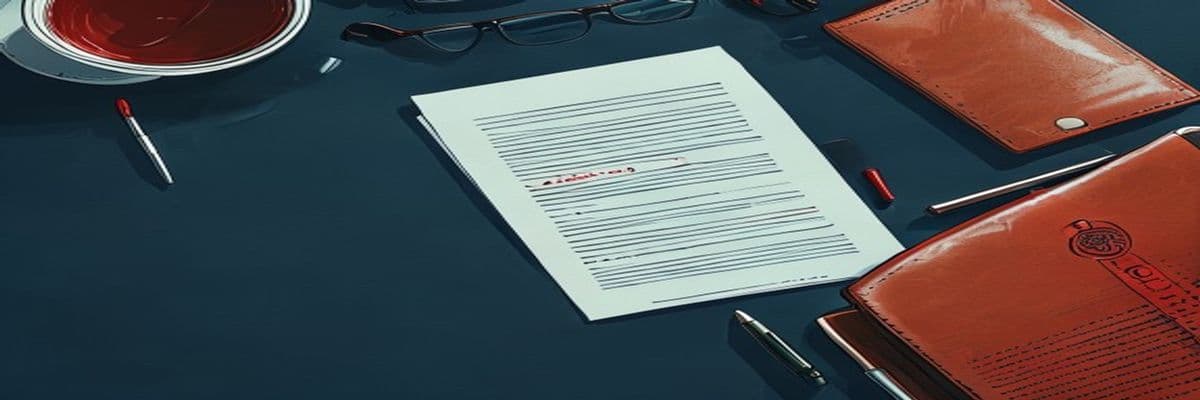
I moved it to the top of the document.
Then I moved it back.
The problem was that it was too good. There's a thing that happens with political writing: the sentence that's technically strongest is often the one that lands wrong in the room, because a room is not a page. Senators' colleagues were going to sit there listening to Whitfield read these words aloud, and some of them would hear "the watchmen are themselves being watched" and think: good policy. Others would hear it and think: threat. The line between those two readings was invisible, and my job was to see it before Whitfield stood at that lectern and crossed it by accident.
I thought it was visible enough to be worth the risk.
Whitfield would probably disagree. He usually did, on the things I cared most about.
I picked up my red pen and made a note in the margin: Keep. Fight for this one. Then I flipped back through the draft from the beginning, reading it the way I'd taught myself to read everything: as if I were sitting in the back of the room, hostile, waiting to be shown something I hadn't expected to believe.
This was the sixth draft. Whitfield had given me the policy parameters two weeks ago, a twenty-minute meeting where he sat with his hands flat on the table and talked through the argument in the measured, unhurried way of someone who had been building the same case for three years and knew every joint and load-bearing wall of it. Intelligence oversight reform. Not abolition, not overhaul, reform. The distinction mattered to him and he wanted it to matter to the floor. My job was to make it matter.
I understood the argument. I believed in it. Both of those things made the work harder, not easier, because belief has its own gravitational pull and I'd learned long ago that writing from conviction without discipline produces speeches that preach to the converted and lose everyone else. The people you needed to convince were never the ones who already agreed with you.
Draft one had been too dense, too much policy scaffolding visible. Draft two had swung too far into narrative and lost the legislative precision. Three and four were iterations, tightening and balancing. Five I'd been almost satisfied with. Six I'd pulled apart at the seams, stripped it back to the skeleton, rebuilt.
Six was almost right.
I turned back to the transparency paragraph and stared at it.
The printer by the door had a small orange indicator light that blinked every thirty seconds when it was idle. I had never noticed it until about two weeks into the job, and then once I noticed it I couldn't un-notice it, and now it blinked at me like a slow, patient question in the background of every late night I spent in this room. Which was most of them.
I picked up my red pen and made a note in the margin: Keep. Fight for this one. Then I closed the document, sent it to print, and stood up.
Two years ago, when I interviewed for the position of chief speechwriter to Senator Arthur Whitfield, D-Virginia, Chairman of the Senate Intelligence Committee, I had been sitting in a different office in this same building wearing a blazer that was slightly too large in the shoulders because I'd bought it the week before my Harvard Kennedy School commencement and had been running on stress and coffee since. Whitfield had looked at my writing samples for approximately forty-five seconds and then looked up at me with those pale grey eyes and said: "You write like you already know what I'm going to say. Most people write like they're hoping I'll say what they want."
I said: "The difference is that I do know what you're going to say, Senator. I've read every floor speech you've given in thirty years and tracked every rhetorical pivot in your public positioning since the party realignment in 2014. This is who you are on paper. I'm here to make you that person out loud."
He held my gaze for a moment. "And if what I am on paper isn't quite who I am in practice?"
"Then I renegotiate," I said. "But I'd need evidence first."
He hired me.
I was twenty-six. I was the youngest chief speechwriter on the Hill by four years.
I won't pretend the pride didn't taste like something real.
The clock on my laptop read 10:47. I saved the draft, emailed it to myself as backup, and collected the two printed copies from the laser printer by the door: one for Whitfield, one for me. The printer made a sound like someone losing an argument in another language, which was routine. I'd learned to ignore it around week three.
I capped my red pen and slid it into my blazer pocket. Force of habit. I'd lost too many good pens to clean desks and borrowed-and-forgotten.
Then I stood up and stretched and looked around my office, as I did most nights, at the particular disorder of a person who spends most of her waking hours inside a windowless room trying to put into words things that are inherently resistant to language.
The room was small. Just big enough for the desk, a filing cabinet, a narrow bookshelf jammed with policy briefs, Congressional Research Service reports, a dog-eared copy of Orwell's "Politics and the English Language" that I'd had since undergrad and referred to with embarrassing frequency, and a framed photo of my father on the shelf's top row. Karim Farah, CIA analyst, born Beirut 1961, died Washington D.C. 2010, survived by a wife, a daughter, and a son who still couldn't talk about him without a silence in the middle of the sentence.
The photo was from 1997. He was standing in front of the Georgetown main gate, holding my hand. I was six. He had the slightly-too-formal posture of a man who'd grown up in a country where photographs were an occasion, and the expression of someone who was keeping something very good to himself. A private happiness. He had that expression a lot.
I was wearing his Georgetown sweatshirt right now, under my blazer. It was falling apart at the cuffs. I wore it when I worked late because he used to work late, and the logic of that comforted me in a way I'd never explained to anyone.
On the wall across from my desk, a large map of the Middle East with pins in it. Every city where my father had been stationed, all the places whose names he'd mentioned in passing over dinner when I was a child, the geography of a life I'd only ever gotten in fragments. Beirut. Cairo. Amman. A few others I'd added by inference, cross-referencing public records with the vague coordinates of his stories. My best friend Lena had seen the map once and said it looked like a conspiracy board, and I'd said it was a memorial, and she'd said those things weren't mutually exclusive, and I'd told her to stop being perceptive before noon.
I picked up the speech draft and my keys and turned off the desk lamp.
The hallway outside was the kind of quiet that only happens in large buildings after hours. Not silence, but the absence of human activity over a mechanical baseline. The ventilation system. The distant thrum of the elevator banks. The fluorescent strips in the corridor ceiling casting a light that turned everything slightly institutional, slightly yellowed, the kind of light that makes your own hands look like evidence. My footsteps on the carpet were absorbed. Everything was absorbed. The Hart Building at ten-thirty at night was a machine with no one at the controls, running on its own momentum.
I passed the atrium overlook and paused for a moment, as I sometimes did.
From the eighth-floor walkway, you could look down into the full height of the space: ninety feet of white Vermont marble walls dropping to the atrium floor, and at the centre, Alexander Calder's "Mountains and Clouds" filling the void. The 36-ton black steel mountains rose from the floor. The 75-foot mobile was suspended above them in flat black shapes that from this height looked like they were actually moving even when they weren't, which they always seemed to be doing even when they weren't. The skylight above the whole thing was dark at this hour, which meant the atrium lights below gave everything a strange theatrical quality, the sculpture illuminated from the bottom up, casting long shadows that reached up the marble walls and disappeared somewhere around the third floor.
I'd walked past this view five hundred times. I still looked every time.
There is a kind of beauty that is specifically the beauty of serious things. The kind that doesn't try to please you. I thought about that sometimes, about how the building's designers had put the most demanding art they could find at the centre of the space where senators walked every day. As if beauty was a responsibility. As if the work required witnessing.
Then I thought: you've been up since five-thirty and you're romanticising federal architecture, which is a sign it's time to deliver this draft and go home.
I kept walking.
The corridor outside Whitfield's suite was empty except for one of the night janitors pushing a cart toward the supply closet at the far end. I registered him in my peripheral vision the way you register anything recurring and unremarkable: the cart wheels needed oil, they made a specific sound on carpet that was different from the sound they made on the marble near the elevator, and I'd heard it enough nights to know it without looking.
I was halfway to Whitfield's door when something made me look anyway.
The janitor was maybe sixty, stocky, with the kind of economical movement that doesn't come from efficiency but from a body that has learned to carry weight over a long time. His sleeves were rolled to the elbow in that particular way where the cuff gets pushed up rather than folded, a working-man's roll, not a casual one. His left forearm was resting on the cart handle.
On the inside of his left forearm, faded to the blue-grey of old ink: a tattoo. I couldn't read it from here, but the shape was clear enough. Military. Not the decorative kind. The functional kind, the kind you get when you're young and you want to belong to something, and the something is a unit.
I filed it. I don't know why. I file things by reflex; it's not always clear why until later.
He rounded the corner and disappeared.
I reached Whitfield's outer office. The anteroom was dark, his administrative staff having been gone since six. The door to the inner office was slightly ajar, light coming through the gap.
I heard his voice before I knocked. The particular rhythm of a phone call, measured and low: "...that can be managed. The question is the timeline. If they move before we're positioned." A pause. "I understand. That's what I'm saying." Another pause, longer. His voice dropped further. "Then we agree it has to happen before the recess. Yes. Good."
I knocked.
The silence on the other side of the door was about one second longer than it needed to be.
"Come in."
I pushed the door open.
Senator Arthur Whitfield was standing behind his desk, phone already face-down, hands braced on the desktop in a posture that I recognised as his I-have-just-concluded-an-important-call posture, which I had seen many times. But something about his face, for the half-second before he registered that it was me, was wrong.
Not wrong in a definable way. Wrong in the way a sentence is wrong before you've identified the error: you register the wrongness before you can name it. His features were arranged differently than usual. Rawer. The face under the face. The thing that existed before thirty years of public life had taught him to put the other thing over it. His eyes were doing something with the light from his desk lamp, the calculation behind them not quite hidden.
Then the mask slid back.
The measured smile. The warmth that was entirely genuine and entirely controlled simultaneously. He was good. He was, probably, the best I had ever seen.
"Nadia." He straightened. "Still here."
"I wanted to get you the draft tonight so you have it for morning." I crossed to the desk and set the printed pages in front of him. "Floor speech for Tuesday. I'm happy with it but I have one note in the margin I want to flag before you mark it up."
"Of course you do." He said this with the particular affection of a man who had learned to find his employees' tenacity charming rather than exhausting, which was either genuine management skill or excellent performance. Probably both. He sat down and pulled the pages toward him and put on his reading glasses (wire-framed, which he only wore in private, because in public he had contacts for the cameras) and began reading.
I stood and waited. There's a ritual to this part. You deliver, you wait, you don't rush him. You read the room while he reads the document and you adjust your arguments accordingly.
So I read the room.
His desk was large, dark wood, the kind of desk that had been in this office for decades and had absorbed the weight of all the decisions made on top of it, or so I preferred to imagine. The surface was orderly. Whitfield was orderly as a matter of discipline, not temperament, which was a distinction that mattered. A desk lamp with a green glass shade. A tray of correspondence. His phone, face-down. A crystal water glass with an inch of water in it, the kind of small detail that told you his assistant had been in to set up the room earlier that evening.
And on the corner of the desk, where it had always been, the framed photograph.
I'd walked past that photograph for two years. I had looked at it the way you look at background scenery: present, peripheral, not catalogued. But something made me focus on it tonight, the same reflex that had made me look at the janitor's arm. The mind latching onto things it's not sure why it needs yet.
A black-and-white photo, but recent enough to be digital and printed in monochrome for the aesthetic. Whitfield, younger (late thirties, maybe forty, before the silver had fully taken the brown) in shirtsleeves, shaking hands with a man. The handshake was the grip of equals or near-equals, not the kind between a senator and a constituent. The man was in a leather jacket. Behind them, partially visible: the architecture of what looked like an embassy or government building, high ceilings, a formal entranceway, something Mediterranean in the window proportions. The man's face was at a slight angle to the camera and caught in shadow. You could read his body language but not his expression, not his features. Big build. Dark hair, maybe. A ring on his right hand.
I looked away. Filed it.
"Eloquent," Whitfield said. He'd reached the last page. He picked up his own pen (heavy, fountain, the kind of pen that costs as much as a month of someone's rent) and made one mark.
I watched his hand. The mark was in the margin of the paragraph about transparency.
"I want to remove this line," he said. He read it aloud: "The watchmen are themselves being watched." He set the pen down. "It reads as naive."
"With respect, Senator."
"I knew that was coming." Not unkind. He looked up at me over the reading glasses.
"It's the strongest line in the speech. It's the fulcrum of the oversight argument. Without it, the paragraph becomes a general statement about democratic principle rather than a specific claim about accountability, and the specificity is what gives it teeth."
"The specificity," Whitfield said, "is also what gives my colleagues reason to hear it as a provocation. There are members of the Intelligence Committee who will hear 'the watchmen are being watched' and spend the next three days calling my office to find out which watchmen I mean." He leaned back slightly. "We are making an argument for reform, not picking a fight."
"Sometimes the fight is the reform."
He smiled. It was a genuine smile (I knew his genuine smiles) and there was something in it I couldn't name, something that might have been appreciation if it hadn't been tinged with something else, something almost like regret. "You're not wrong," he said. "But you're wrong about the timing. Take out the line. The rest of the paragraph carries the argument."
I looked at the speech. He was right that the rest of the paragraph carried it. I was also right that the line was the fulcrum, and without the fulcrum the argument lost a degree of precision. We were both right about different things. The line would come out. That was the nature of the job: you argued for what you believed was correct, and then you deferred to the person whose name was on the letterhead, because that was the agreement you made when you walked in.
"I'll revise tonight and send you the clean version before seven."
"Thank you, Nadia." He was already turning back to the page, marking something else. "Go home."
I collected my copy of the draft, tucked it under my arm. I was at the door when I heard the pen stop moving.
"You know what I admire about your writing," Whitfield said, without looking up.
I waited.
"It has conviction." He was quiet for a moment. "That's rarer than people think. Most political writing is designed to simulate conviction. Yours is the real thing. Don't let anyone argue it out of you."
I considered, not for the first time, the strange architecture of working for Arthur Whitfield. He was a man who could tell you, with complete sincerity, not to let anyone argue out of you the thing he had just finished arguing out of you. Who could praise your instincts in the same breath as overriding them. Who made you feel seen and managed in the same sentence and left you unable to separate the two.
This was the thing about him. He could say something true and generous and the warmth was not performed (or at least the performance was indistinguishable from the real thing) and then you would leave his office carrying that warmth and the simultaneous awareness of the line he'd just struck through your best paragraph, and you would have to hold both things at once. That was a skill I had been developing for two years and had not yet perfected.
"Goodnight, Senator."
I pulled the door closed behind me.
I stood in the anteroom for a moment and did not examine what I was carrying, because I was a professional and it was almost eleven at night and whatever had settled in my chest was the kind of thing that required a clear head to sort through. A hairline fracture in something. The precise location of the fracture unclear. The structural integrity of the surrounding material, for the moment, intact.
I called it professional disagreement and moved on.
I started toward the door, and then I paused.
Whitfield's administrative assistant kept his official public schedule in a binder on the credenza by the door, updated every Monday, available to the full senior staff. His private calendar (the one that included his personal appointments, donor calls, events he attended in a personal rather than official capacity) lived on a separate system, visible to his chief of staff, his scheduler, and as a function of a permissions error that had never been corrected and that I had never mentioned, me.
I had never mentioned it because it wasn't my business and because I was not someone who rooted through her boss's private calendar looking for leverage or gossip. I was someone who wrote his speeches and believed in his work and kept her head down and her drafts sharp.
The iPad that showed the private calendar was face-up on the corner of the credenza.
The light was still on.
I wasn't looking for anything. I don't want to tell it as though I had a premonition, some reporter's nose or a spine that tingled. I looked at it because I was standing next to it, and I look at things. It's what I do. Two years of operating inside a political office had encoded certain habits into my nervous system that I couldn't switch off. I read things. I noticed things. I filed things.
Next Thursday evening. A block of time from 7:30 to 10:00 PM, no location listed in the description field, which was standard for private events. But in the subject line, which was where his scheduler sometimes put shorthand notes:
Lafayette Room, Hay-Adams, 8 PM.
No attendee names. No context note. No indication of purpose.
The Hay-Adams was six blocks from here. The Lafayette Room was its private dining space. I'd been there once for a fundraiser, tucked behind glass doors off the main restaurant, white tablecloths and an ornamental fireplace and a view of Lafayette Square framed in tall windows, and the particular quality of candlelight that high-end hotels achieve, which makes everyone in the room look like they're on the right side of a decision. Uniformed waiters. Overhead chandeliers. The White House visible through the glass, which was either a view or a reminder, depending on who you were.
Whitfield had dinner out frequently. I didn't track his personal schedule.
But his personal schedule didn't usually appear in this calendar system.
And the entry had no attendees.
I set the iPad down. I picked up my draft and my keys and left.
The elevator down to the lobby was slow. The Hart Building elevators are always slow, which is a thing you accept on the way up because you're in a hurry and it tests you, and accept on the way down because you have nowhere to be and you're tired and the pause is almost pleasant.
The lobby at this hour had the particular quality of a large institutional space emptied of its purpose. The security desk near the entrance: one guard, half my age, working his way through something on a phone he'd angled below the desk surface with what he clearly believed was subtlety. The polished floors reflecting the overhead lights. The front entrance, the revolving doors, and beyond them Second Street NE, the Capitol visible two blocks west, lit up in that specific white light they keep on all night, the dome floating above the dark.
I pushed through the revolving door.
The night was cold for late October, a wind coming off the Mall, the kind that finds the gap between your collar and your scarf and lodges there. I pulled my coat tighter. The street was quiet, a few cars, the distant sound of a siren somewhere northeast that faded before it arrived. I found my phone in my bag and started toward the garage.
The email notification came in while I was fishing for my keys.
I almost didn't look. I had a rule about checking email after ten-thirty, which I violated approximately four times a week, and this was already eleven, and the rule was there for reasons of psychological self-preservation that my therapist (I had not seen my therapist in five months, which was itself a data point) had been very clear about.
I looked.
The sender was the Office of Senate Security Coordination, which I received emails from approximately twice a year, usually about updated badge protocols or building access procedures. The subject line read: Protective Detail Assignment. Senate Intelligence Staff.
I stopped walking.
There had been a general security briefing two weeks ago about enhanced protocols for senior Intelligence Committee staff. Something about elevated threat assessments, which was language that got used often enough on the Hill that it had become administrative wallpaper. I'd sat in the briefing between two legislative directors who spent most of it on their phones, and the man from Senate Security had talked for thirty-five minutes in the tone of someone reading a policy manual aloud, and I had taken notes out of habit and filed them in a folder I'd never opened.
I had not expected a personal assignment.
The email was brief. Effective Monday, personal protective detail assignments will be in effect for senior staff of the Senate Intelligence Committee during the current elevated risk period. Your assigned agent is SSA Elias Kade, United States Secret Service. Agent Kade will contact you Thursday to coordinate logistics. Questions regarding this assignment should be directed to the Senate Security Coordination Office.
SSA. Supervisory Special Agent. Not a junior placement.
I stood on Second Street in the cold and stared at the email for a moment, and then I did what I did with any new variable in a situation I was trying to understand: I gathered information.
I opened my browser and typed: Elias Kade Secret Service.
The results were sparse. A LinkedIn page with no photo and a single current employer entry, no details, connections listed as zero. A brief mention in a government press release from 2019 about a protective detail rotation at a diplomatic summit, his name listed as one of approximately twelve agents, no further information. A White Pages entry with an address in Arlington, Virginia.
Nothing else.
No photographs. No public records from prior assignments. No PACER entries, no news mentions, no conference appearances, no professional profiles of the kind that senior federal law enforcement agents almost always accumulated over a career. The internet had almost nothing to say about Supervisory Special Agent Elias Kade.
I stood there with the Capitol lit up two blocks away and the wind finding the gap in my collar again, and I thought about what it meant for a federal law enforcement officer with a supervisory rank to have essentially no digital footprint.
The most obvious explanation was that he worked sensitive assignments and his profile was deliberately kept clean. That happened. It was not uncommon for agents assigned to protective details involving classified operations or high-threat principals.
The second most obvious explanation was worse.
I closed my browser and put my phone back in my bag. I found my keys. I walked the rest of the way to the garage.
The fluorescent lights in the garage flickered once when I pushed through the stairwell door. The sound of my footsteps changed, harder here, the concrete eating nothing. Level B2, row four, the blue Honda Civic I'd had since graduate school and kept meaning to replace.
I sat in the driver's seat and did not start the car.
The Civic was cold. My breath was visible. Somewhere in the structure above me a car alarm was going off on a long intermittent loop, the sound bouncing between concrete levels, and I sat there and thought about a federal agent with almost no results on the internet, and a private calendar entry with no attendees, and a janitor with a military tattoo whose rolling cart made an oiled sound on marble and an unoiled sound on carpet.
Three things. Three things that were each individually explainable. Three things that shared no connection I could currently demonstrate.
I started the car.
The phone was in the cupholder. The browser was still open.
I picked it up and typed his name one more time, this time with quotation marks: "Elias Kade."
Six results. The same LinkedIn stub. The same summit press release. The same White Pages entry in Arlington. Two results I'd somehow missed the first time: a cached page from a government directory, 404 now, that had listed him as assigned to the Joint Protective Operations Division, which I had never heard of, which was itself not remarkable given the number of things I'd never heard of that the government apparently contained. And a forum post on a law enforcement professional network, dated four years ago, from someone asking if anyone had worked with a Kade from Joint Protective Ops, that had two replies.
Both deleted.
Deleted replies on a law enforcement forum, about a man who had almost no other trace online, who was being assigned to my personal detail starting Monday.
I set the phone down.
Federal law enforcement agents had records. They had professional histories. They had audit trails the way any government employee had audit trails, because that was the nature of operating inside a bureaucratic system. You left marks everywhere. You were designed to leave marks. The absence of marks was not neutral. The absence of marks was a mark.
That was worth thinking about.
I pulled out of the parking spot.
The Capitol was still lit at the end of the street, the dome white against the black sky, floating there above the city the way it always floated: permanent, composed, utterly indifferent to what went on beneath it. I turned south and the rearview mirror held it for a moment and then it was gone.
Monday. He was coming Monday.
Supervisory Special Agent Elias Kade, who did not appear to exist.
I drove home through the empty city, the speech draft on the passenger seat, the transparency line already struck through in Whitfield's precise red ink. The particular awareness I had learned to pay attention to over two years of reading rooms for a living settled into my chest like a stone dropping into still water. Not a splash. Not a ripple. Just the stone, descending, finding the bottom.
Something was beginning.
I didn't know what yet.
But it had already started, and I hadn't been looking, and that was the kind of thing that kept you awake.
I drove home.
What did you think of this chapter?
Drop your thoughts and get notified when new chapters arrive. The author reads every message.
Continue reading
Chapter 2→