The Ashford Hotel smelled like money and gardenias.
Not real gardenias. The Ashford hadn't used real flowers in the lobby since the renovation in 2019. These were diffused through the ventilation system, a custom scent developed by a perfumer in Grasse who charged six figures to make a building smell like old wealth and good taste. I knew this because my father owned the hotel. I knew this because I had approved the invoice. I knew this because noticing things like artificial floral scent was how my brain kept itself from screaming in rooms where screaming was not allowed.
I counted exits. Front entrance, thirty feet behind me. Service corridor left of the concierge desk. Fire stairs through the door marked STAFF ONLY. Freight elevator at the end of the east hallway. Four ways out. Filed. Moving on.
The private dining room was on the second floor. The Monarch Room, named for the butterfly motif in the crown moulding, though I'd always thought it was named for what monarchs did best: sit in gilded rooms and decide who lived. Tonight, two families would sit in this gilded room and pretend they hadn't spent thirty years trying to destroy each other. Tonight, I would meet the man I was going to marry.
Lena was waiting outside the double doors. Emerald green dress, statement earrings, curls pinned half-up in a way that looked effortless and had almost certainly taken forty-five minutes.
"You're late," she said.
"I'm exactly on time."
"Your father arrived twenty minutes ago. In Victor Maren's world, on time is late. You know this."
"I do. I chose to arrive at the time printed on the invitation."
She wanted to argue. She looked at my face and decided against it.
"You look good," she said instead.
I looked calculated. Black dress, fitted, high neck, long sleeves. No jewellery except my mother's watch. Hair down, which I almost never wore, because Lena had said, Wear it down, it makes you look less like you're about to cross-examine someone. She had a point.
"How many inside?" I said.
"Twelve at last count. Your father, his lawyer, two security. Gianna Valenti, Luca Valenti, three men I don't recognise, and a woman in black who looks like she could kill me with a salad fork."
"That's the mother."
"She's terrifying."
"She's five-three."
"Terrifying isn't a height requirement, Sera."
"And Nico?"
"Not yet."
Something loosened in my chest. A reprieve. Time to enter and position myself before he arrived.
"Let's go."
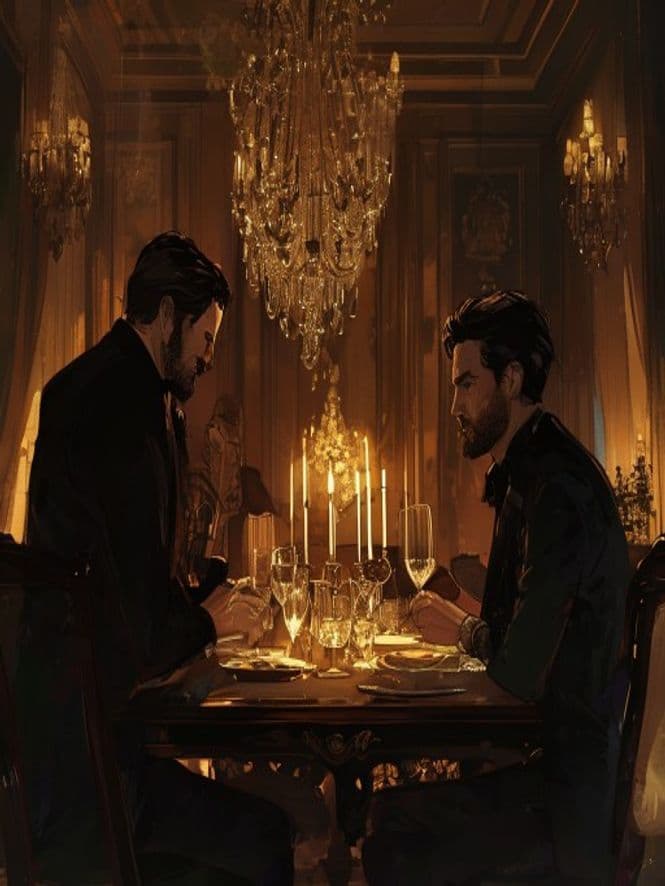
The Monarch Room hit me first as colour. Gold leaf on the ceiling, gold frames on the oil paintings, gold-rimmed china on a table long enough to seat twenty. Crystal chandeliers hung at intervals, three of them, dripping light like something liquid. White linen, tall candles in silver holders, white roses and dark greenery that smelled sharp and alive. The walls were panelled in dark wood that caught the candlelight and held it, giving the room the feeling of the inside of a jewellery box. Floor-to-ceiling windows along the far wall overlooked Central Park, the park a dark sprawl beyond the glass, dotted with the distant orange of lampposts.
Beautiful. And a cage.
My father stood at the head of the table with scotch. Charcoal bespoke, silver hair swept back, his signet ring catching light as he turned it. Once. Twice. He was nervous.
"Sera. You look well."
"Thank you."
"The Valentis will arrive shortly. Gianna is already here."
"Power move."
His jaw tightened. He couldn't deny it. Gianna Valenti had walked into his hotel twenty minutes early and claimed the space. She sat at the far end of the table now, a small woman in black, silver-streaked hair pinned in an elegant knot, a glass of red wine she hadn't touched. She was watching me the way a cat watches a bird it hasn't decided to kill yet.
My father's hand caught my elbow. "Be gracious tonight. Smile. Make her believe this is something you want."
"I'll handle it."
I walked the length of the table. Twenty-two steps. The candles flickered as I passed.
"Mrs. Valenti. Thank you for coming."
"Gianna," she said. Her voice was lower than I expected, accented, warm the way a cast-iron pan is warm: useful and capable of burning you. "We are to be family."
"Gianna." I offered my hand. Her grip was firm and brief.
"You have your mother's face," she said.
"You knew my mother?"
"I met her once. A lifetime ago. She was very beautiful. Very quiet." Gianna's eyes moved across my features like fingers reading Braille. "You have her bones. But your eyes are your father's."
"I've been told."
"It was not a compliment."
Lena, somewhere behind me, made a sound like a swallowed cough. Gianna's expression didn't change. It wasn't hostile. It was honest, which was worse.
"Sit," Gianna said. "We'll talk while the men arrange themselves."
A waiter poured wine without asking. I lifted the glass and didn't drink.
"You are not what I expected," Gianna said.
"What did you expect?"
"Someone softer. Victor's daughter, I thought, would be polished glass. Pretty and breakable. You are not breakable."
"Thank you."
"It was not a compliment either."
I felt something I hadn't anticipated: respect. Not trust, not warmth, but the specific regard of one strategic woman recognising another.
Then Luca Valenti walked in, and the room shifted.
Six feet, lean, dark hair slicked back, green eyes that swept the room with lazy confidence. Navy suit, no tie, gold watch catching candlelight. A snake tattoo wound from his right wrist up beneath his cuff. He was beautiful the way sharp things are beautiful: you admired them right up until they opened you.
He found me immediately. Crossed the room, took my hand before I offered it, and raised it to his lips.
"Sera Maren." His mouth grazed my knuckles. His eyes didn't leave mine. "My brother's bride. I've been looking forward to this."
"Have you."
"A beautiful woman joining our family? Of course." He stayed close. I could smell his cologne, cedar and something darker. "I only wish it were me walking you down the aisle."
He said it lightly. A joke, or the shape of one. But his thumb was resting on my knuckle, and the pressure was a fraction too deliberate to be accidental.
"I'm sure you'll survive the disappointment."
He laughed. Quick and bright, reaching his eyes just enough to be convincing. He was charming the way a pickpocket is charming: the warmth was there to distract from the hand in your pocket.
"Luca." Gianna's voice carried the weight of a closing door. "Sit down."
He winked at me and took his seat across the table. I catalogued him: dangerous, charismatic, resentful. A thread I could pull, or one that could unravel me.
But it was the seat he chose that interested me. Directly across from where Nico would sit. Not beside his mother. Not at the far end, where distance could masquerade as deference. He sat where his brother would have to look at him all night, and the placement had the precision of someone who had been mapping power dynamics since he was old enough to understand them.
The door opened again.
Nico Valenti entered the way silence enters a room: without announcement, but suddenly everything else was quieter. His eyes swept the table and landed on Luca, who was still leaning toward me, still too close, still wearing the residue of that kiss-the-hand performance. Nico's jaw tightened. One controlled flex of muscle, barely visible in the candlelight, and then gone. Luca saw it. He smiled wider. Gianna's hand moved to her wine glass. The three Valenti men by the door straightened like dogs hearing a whistle.
Six-two, broad through the shoulders, black on black, tailored to the millimetre. No tie. Rolled sleeves. A watch on his left wrist that looked old, well-worn, kept because someone he loved gave it to him. Dark hair pushed back, stubble shadowing a jaw that could have been drawn with a straight edge. The thin scar bisecting his left eyebrow. Eyes so dark they looked black in the candlelight.
I had expected a brute. I had built him in my mind as something crude, a man who led through force. I had made him simple because simple enemies are easy to destroy.
He was not simple.
He moved quietly for his size, and the quiet unsettled me. Greeted my father with a brief handshake. Kissed his mother's cheek and murmured something in Italian that made her touch his face. Passed Luca without stopping. Luca's jaw tightened, barely, a micro-expression that lasted less than a heartbeat. I caught it. Filed it. Brothers who loved each other didn't look like that. Brothers at war did. Then Nico straightened and looked at me.
Just looked. Dark eyes steady, expression neutral, giving nothing.
I looked back. I had told myself I would study him clinically, as a problem to be solved. But looking at Nico Valenti was like staring into a room with no lights on and knowing something was in there, something that could hear you breathing.
He held my gaze. I held his. The room, the candles, the crystal, all of it receded, and for four seconds there was nothing except his eyes on mine and the terrible feeling that he was not just looking at me but reading me, turning pages I hadn't given him permission to open.
I looked away first.
It happened before I could stop it. My eyes dropped to the linen, the gold-rimmed plate. A flinch. I had looked away first, and he had seen it, and the knowledge sat in my chest like a coal.
When I looked up, he was pulling out the chair beside mine.
"Sera," he said. "We finally meet."
"We've met."
"We've been in the same room. That's different."
He sat. He smelled like something clean and warm, the faintest trace of smoke underneath, like a fireplace in a house where someone actually lived. I hated that I noticed.
"You're right," I said. "It is different."
He didn't smile. He watched me the way you watch weather changing. Like he was noting where the clouds were and calculating when the storm would hit. I straightened my knife beside my plate. Aligned it parallel to the fork. Small controls. Small comforts.
Dinner was served. Seven courses. The first was a bisque poured tableside from a silver tureen, steam curling through candlelight. My father spoke to Gianna about Midtown property. Gianna responded with the ease of a woman who could discuss real estate while calculating the cost of betrayal. Luca charmed Lena, who was seated beside him and alternating between laughter and the expression she wore when cross-examining a hostile witness. The Valenti men ate in silence. My father's security watched them. Their security watched back. Everyone performed. Everyone knew it. The candlelight made it all look warm, and the wine made it all feel possible, and I reminded myself that this was what danger looked like when it put on a suit and sat down to dinner.
Nico ate without speaking. He held his fork the European way, and his hands were large, scarred across the knuckles, capable of things I refused to think about while close enough to touch him. He didn't fill the silence between us. He simply existed beside me, and the silence had a texture I could almost feel on my skin.
I broke first. Again.
"Tell me something," I said, low enough for only him.
He turned his head. This close, I could see the scar in detail. Someone had opened his face once, and he'd let it heal without hiding it.
"Ask."
"Why did you agree to this?"
"The alliance is strategic."
"That's your mother's reason. I'm asking for yours."
He set down his fork. Picked up his wine. Turned the glass slowly.
"My father spent the last year of his life trying to build something with your family. He died before he could finish. This marriage finishes it."
"Better answer. Still not yours."
His jaw tightened. The muscle flexed once, then released.
"I don't give away answers for free, Sera."
"What's the price?"
"Time. Ask me again in a year."
Across the table, a man leaned into the candlelight. Stocky, five-ten, buzzed brown hair, a nose broken at least twice. Leather jacket in a room full of suits. Kind eyes that were absolutely devoid of trust, fixed on me.
"Marco," Nico said without looking away from me. "Stop staring at my wife."
"She's not your wife yet," Marco said.
"A technicality. Sera, Marco DeLucci. He handles my security."
"He handles more than that," I said.
Marco's eyes narrowed. Not anger. Interest. The interest of a man who'd been identified and was recalculating.
"I do my homework," I said.
"So do I," Marco said. He didn't blink. He watched me the way you watch a door you expect to open from the wrong side.
Midway through the fourth course, my father tapped his glass. The room stilled.
"I'll keep this brief." He stood. Candlelight carved his face into planes of shadow. "Tomorrow, our families join. But tonight, I want to speak to something contracts don't cover. Legacy. The Marens and the Valentis share a history. It has not always been kind. But my daughter carries the best of this family forward. I trust her to represent us well."
He looked at me. For less than a second, something moved behind his eyes. Something like guilt. Then it was gone, and he was raising his glass.
Nico stood.
The room went quiet. Not polite quiet. Held-breath quiet.
"To new beginnings," Nico said. His voice carried without effort. He held his glass before him, wine dark as blood against his scarred knuckles. "And to the courage they require."
He looked at me when he said courage. Directly at me. He turned his head and fixed those black eyes on mine and placed the word in the space between us like he was handing it to me.
This time, I did not look away. I held it until the glass came down and his mouth was wet with wine and the candlelight caught the scar through his brow, and I thought: You don't scare me. Which wasn't true. But I needed it to be.
The table drank. Conversation resumed. But the word stayed lodged behind my sternum, pulsing. Courage. A challenge. Or a warning.
The remaining courses passed. I spoke to Gianna about ceremony logistics. Deflected Luca's wine refills. Exchanged three sentences with Marco about Brooklyn parking, which was either the most mundane conversation of my life or a test I couldn't identify. Through all of it, Nico sat beside me and said very little and took up an unreasonable amount of space. Not physically. Something about his presence bled past its boundaries, a gravitational field I kept drifting toward and correcting away from.
I excused myself. The hallway was cool and dim after the dining room's candlelit heat. I leaned against the wall and pressed my fingers to my temples.
A hand touched my arm.
Gianna. Small and straight in black, green eyes bright. She spoke. Italian, rapid and low, a sentence I caught fragments of but couldn't assemble. Her hand was firm on my arm, her eyes holding mine with an intensity that felt like a transfer. She was giving me something. I couldn't read it.
"I don't speak Italian," I said.
"I know." And then, in English: "Learn."
She walked back in. The door swung shut.
I stood replaying the words, syllable by syllable, feeling them slip.
The door opened. Nico.
He leaned against the opposite wall, hands in his pockets.
"She does that," he said.
"Does what?"
"Tests people in languages they don't speak. She wants to see how you react to not understanding."
"And how did I react?"
"You tried to memorize what she said. I watched your lips move."
I folded my arms. "Are you going to tell me what she said, or are you going to stand there looking enigmatic?"
The corner of his mouth shifted. Not a smile. A fracture in the mask.
"She said: Le donne che sopravvivono a questa famiglia sono quelle che smettono di fingere."
"Translation."
"'The ones who survive this family are the ones who stop pretending.'"
The words settled over me like a change in temperature.
"Good advice," I said.
"My mother doesn't give advice. She gives warnings."
He pushed off the wall. At his full height, I had to tilt my chin to hold eye contact.
"Courage," I said.
"What?"
"Your toast. What did you mean?"
He was quiet. Five seconds. Ten. The hallway clock ticked.
"I meant that tomorrow, you and I stand in front of everyone we know and promise things we don't yet mean. And the only honest thing about it will be the courage it takes to do it anyway."
He held my gaze one more breath. Then he turned and walked back in, and I was alone with the gold wallpaper and the echo of a man who had handed me the truth like a lit match and walked away.
The dinner ended at eleven. My father told me I'd done well. Lena hugged me in the lobby and whispered, "He watches you," and I said, "I know," and she said, "No, Sera. He watches you," and I chose not to examine the emphasis.
My apartment. Thirty-second floor, Upper East Side. Clean lines, white walls, a kitchen I used for coffee and nothing else. I locked the door, kicked off my heels, and stood in the dark for twelve seconds.
Then I moved.
The writing desk was walnut, antique, the one piece of furniture I'd chosen myself. I sat and pressed my thumb to the underside of the second drawer. A click. The false bottom released.
Inside: Marcus's notebook. A USB drive, brushed silver, no label. And a photograph.
I picked it up. Slightly faded, creased at one corner. Two men at a table in what looked like a restaurant, warm-toned, low lighting, cloth napkins. The man on the left was Marcus. Younger, maybe twenty-two, leaning forward with his elbows on the table, gesturing with one hand. Talking about something that mattered. I knew the posture. I knew the fire.
The man on the right I did not know.
Older. Fifties. Dark complexion, heavy brows, a strong face that might have been handsome before something carved severity into it. He was listening to Marcus with an expression I couldn't read. Not hostile. Not friendly. Something careful and weighted.
Three years I'd had this photograph. He wasn't in any database I could access, any of my father's files. A ghost sitting across from my dead brother in a restaurant I couldn't name.
I memorised his face again. The heavy brow. The jaw. The slight asymmetry of his nose, broken once and set imperfectly. Every detail committed to the part of my brain where I kept the things that mattered most.
I put everything back. Pressed the false bottom shut. Seamless. Invisible.
I sat in the dark and pressed my thumb to the tattoo. Three.
Tomorrow I would walk into the Church of St. Cecilia and promise myself to a man whose family name was written in my brother's hand in the notebook hidden three feet from where I sat. Tomorrow I would move into his home, eat at his table, sleep on the other side of his wall.
I thought about Nico's voice in the hallway. The way he said courage like he already knew what it would cost.
I thought about Gianna's warning: stop pretending.
I thought about Luca's mouth on my knuckles and Marco's mistrustful stare and the photograph of my brother with a man whose face I would find if it took another seven years.
Tomorrow I walked into the lion's den.
I turned off the light. I didn't sleep.
What did you think of this chapter?
Drop your thoughts and get notified when new chapters arrive. The author reads every message.
Continue reading
Chapter 3→