The building looked dead from the outside. That was the point.
I stood across the street at eight fifty-three in the morning, smoking a Raison Blue and cataloguing every detail the way Minjun had trained me to. Peeling grey paint curling off reinforced concrete walls in strips that reminded me of burnt skin. Ground-floor windows boarded with plywood so weathered it had gone the colour of bone. A rusted loading dock on the harbour side where seagulls fought over something I couldn't see and didn't want to. The whole structure sat on the waterfront like a corpse that hadn't been identified yet, and if you were a tourist, or a cop, or anyone who hadn't been invited, you'd walk past it without a second glance.
Hagu-dong was overcast. The harbour fog had burned off enough to reveal a sky the colour of dishwater, and the air tasted like salt and diesel fuel and the particular metallic tang that meant rain was coming but hadn't committed. Behind me, a delivery truck idled outside a shuttered fish market, its exhaust mixing with steam from a pojangmacha where an old woman was already boiling tteokbokki for the lunch crowd, the red pepper smell so thick it coated the back of my throat.
I finished the cigarette. Dropped it. Crushed it under my boot.
Eight fifty-five. Five minutes to become a different kind of liar.
The entrance was on the east side. No sign, no buzzer. Just a steel door painted the same grey as the walls and a man standing beside it who was roughly the dimensions of a commercial refrigerator. He looked at me with the expression of someone who had been hired specifically for his lack of expression.
"Han," I said. "Dowan's office. Nine o'clock."
He didn't respond. He pressed something on his phone, waited, then stepped aside. The steel door buzzed and I pulled it open and stepped into the Yun Syndicate's throat.
The contrast hit like a slap.
Outside: decay. Inside: control. The entrance corridor was polished concrete, seamless, lit by recessed LEDs that threw a cool, even light without shadows. The air smelled different in here. Climate-controlled, faintly chemical, the smell of money spent on things you couldn't see. Ventilation, soundproofing, the kind of infrastructure that said this building had been gutted and rebuilt from the inside, its rotten shell kept as camouflage around a body of steel and glass.
I walked. My boots were quiet on the concrete. My hands were in my jacket pockets, and my right thumb turned the silver ring against my knuckle, a rhythm that nobody could see and I couldn't stop.
The ground floor was open-plan. A long zinc-topped bar ran along the left wall, bottles arranged behind it with the precision of a museum display. Whiskey, mostly. Japanese and Korean. A few Scotches that cost more than my monthly cover stipend. The furniture was minimal: low leather couches, black, arranged around glass coffee tables. A few men in dark clothing sat in the far corner, talking quietly. They glanced at me and looked away. Nobody smiled. Nobody nodded. The social temperature of this room was approximately zero.
Ahead: a staircase, industrial steel with open treads. A camera mounted above it, the lens tracking my approach with a soft mechanical whir.
"Don't touch the railing."
The voice came from behind me. I turned.
Park Seojin was leaning against the bar with his arms crossed and a look on his face that suggested I'd already failed a test I didn't know I was taking. He was exactly how the file described him: wiry, quick, with sharp features and bleached blond hair that stuck up in calculated chaos. An oversized black hoodie hung off his frame, sleeves pushed to the elbows, revealing forearms corded with lean muscle. An eyebrow piercing caught the LED light. He was twenty-five and looked like a knife someone had dressed in streetwear.
"Seojin?" I asked.
"Seo." He pushed off the bar. "Nobody calls me Seojin except my mother, and she's dead, so." He walked past me toward the stairs, not checking to see if I followed. "Keep up. He doesn't like waiting."
I kept up. First flight: the staircase opened onto a corridor of closed doors. Second flight: another corridor, narrower, with the same polished concrete and recessed lighting. Seojin moved fast, his sneakers silent on the stairs, and I matched his pace while my eyes did what they'd been trained to do. Four cameras on the ground floor, visible. Two on the second floor, positioned to cover both ends of the corridor. The doors were solid, no windows. Keycard access, from the looks of the electronic panels beside each one. Whoever had designed the interior security had been thorough and paranoid, which in this business meant they'd been right.
"How long have you been collecting?" Seojin asked without turning around.
"Two years."
"For us?"
"Who else?"
He snorted. The sound contained no amusement. "Lot of people collect debts in Hagu-dong. Most of them are stupid. You're not stupid. That's what I hear."
"I just follow the numbers."
"Right." He stopped at the bottom of the third flight and turned to face me. His eyes were dark, quick, and they moved over my face the way a butcher assesses a cut of meat. Looking for the line where the knife should go. "Here's the thing, Han. I've been with Dowan since I was sixteen. Nine years. I've watched a lot of men walk into this building thinking they were smart enough to matter. Most of them are gone. Some of them left on their own feet. Some of them didn't."
"That a warning?"
"It's a weather report." He smiled. It didn't reach anything above his mouth. "Don't get lost."
He turned and climbed the last flight. I followed, filing every word, every micro-expression, every detail of the route into the architecture of my memory where Minjun's recorder couldn't reach. The hostility wasn't personal. Or rather, it was entirely personal and had nothing to do with me. Seojin was territorial. I was an intruder in his hierarchy, a stranger being elevated past people who'd bled for their position. His instinct was sound.
That made him dangerous.
Third floor. The corridor here was shorter. Two doors only. One on the left, closed, with a heavier frame than the others and no electronic panel. Just a deadbolt. A room that was locked the old-fashioned way, with a key, and I noted it the way I noted everything: calmly, completely, and with the awareness that nothing in this building was accidental.
Seojin caught me looking. His jaw tightened for half a second before he jerked his chin toward the door on the right.
"Through there. He's waiting."
He didn't follow me in. He leaned against the corridor wall, arms crossed again, and watched me open the door with an expression I couldn't read and didn't try to.
Dowan's office was light.
That was the first thing. After the controlled dimness of the corridors, the room was almost shockingly bright. Floor-to-ceiling windows filled the entire far wall, and beyond them, the harbour stretched out in a panorama of grey water, grey sky, and the rusted geometry of container cranes at Pier 9, their arms frozen mid-reach like metal skeletons praying. The morning light came through the glass diffused by cloud cover, soft and even, and it turned everything in the room into a study in muted tones.
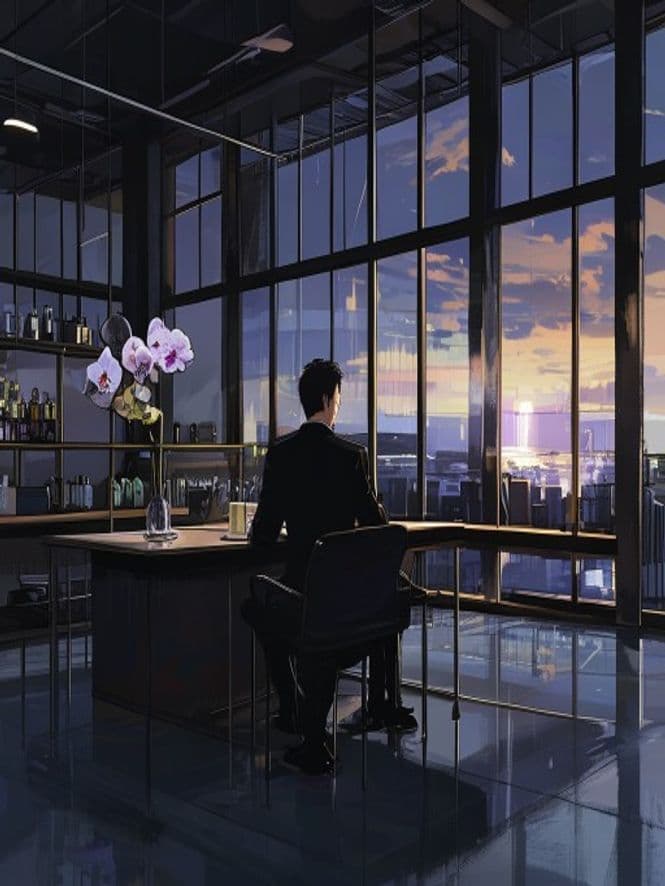
The office was sparse. A black lacquer desk, large, positioned so its occupant faced the door with the harbour at his back. A single chair in front of it. No personal effects on the desk except a laptop, a glass of water, and a ceramic pot containing an orchid. White petals, a single stem, improbably alive in a room that felt like it had been designed to discourage living things. Along the left wall, a bank of monitors showed CCTV feeds in silent rotation: the ground floor, the entrance, the loading dock, angles of Hagu-dong streets I recognised. The wall of eyes. Jaewon's eyes, distributed throughout the district, and this room was where they converged.
The chair behind the desk was occupied.
Yun Dowan did not look up when I entered.
He was reading something on the laptop screen, his face lit from below by the pale glow, and I stood three feet inside the door and waited. The file had given me photographs. Surveillance stills, mostly, grainy, shot from distance. They hadn't prepared me for the physical fact of him.
He was larger than the photographs suggested. Broad through the shoulders and chest, the kind of build that came from use, not vanity, filling out a black shirt that was tailored well enough to follow the lines of his body without straining. His jaw was square, heavy, and his brows were thick and straight above eyes that, in the harbour light, appeared almost black. His hair was cropped close on the sides, longer on top, styled with a precision that said someone took care with it every morning. His mouth was set in a line that communicated nothing.
On his left hand, where it rested beside the laptop, I could see the tattoo. A black chrysanthemum, the petals detailed and dense, covering the back of his hand and wrapping around his wrist before disappearing beneath his sleeve. The Yun family mark. Ink that said ownership the way a brand says ownership, and I thought of cattle, and then I thought of nothing, because he looked up.
The weight of his attention was physical. Not threatening, exactly. Worse. Thorough. His eyes moved from my face to my shoulders to my hands to my boots and back to my face in a circuit that took perhaps four seconds and left me with the distinct impression that he now knew things about me I hadn't told him.
I held still. I kept my face in its default register: mild, attentive, the expression of a man who was competent and uncomplicated and had nothing to hide. Inside, every nerve I owned was firing at a frequency I hadn't felt since training.
"Han." His voice was quiet. Not soft. Quiet the way a room goes quiet before the verdict. Low, unhurried, with a texture like gravel under water. "Sit."
I sat. The chair was wood, uncomfortable by design. Everything in this room served a purpose, and the purpose of this chair was to remind its occupant that they were not comfortable here.
Dowan closed the laptop. Placed his hands flat on the desk, one on each side, the chrysanthemum tattoo vivid against the black lacquer. His fingers were long, the knuckles thickened and scarred, skin split and re-healed over years until the bones beneath looked like they'd been set wrong and corrected by someone who wasn't a doctor.
"Bae's restructure," he said. "The restaurant owner."
"Approved?"
"Being reviewed. You recommended leniency on a fifty-three-million-won default. That's unusual for a collector."
"A dead debtor doesn't generate revenue. A breathing one does. It's arithmetic."
Something shifted in his expression. Not a smile. The ghost of a place where a smile would go, if he were the kind of man who offered them to strangers. "My father's people wanted to liquidate him completely. Take the restaurant, the car, the insurance, and send someone to explain the interest in person. You know what that means."
"I know what that means."
"You talked them into a restructure instead. With a revenue-indexed repayment schedule. That's not arithmetic. That's creative."
I said nothing. Silence was a tool Minjun had taught me early: let the other person fill it. They'll tell you what they think while trying to make you tell them what you know.
Dowan studied me. The harbour light shifted as a cloud moved, and for a moment his face was in shadow, the angles harder, the eyes darker. Then the light returned, and he leaned back in his chair.
"Your file says you did two years in Chungju for assault. Discharged from the army before that. No education past high school."
"That's what it says."
"A man with no education past high school doesn't build a revenue-indexed repayment schedule."
"A man in Chungju has a lot of time to read."
His eyes stayed on mine. Two seconds. Three. The silence was a living thing in the room, and I let it breathe, let it sit between us like a third party who knew more than either of us was saying.
"I have a job for you," he said. "A test, if you want to call it that."
"I'd rather call it a job. Tests imply I might fail."
"You might." He opened a drawer, pulled out a slim folder, and slid it across the desk. "Nam Jungsoo. Owns a construction company in Sangji District. He borrowed two hundred million won through a chain of intermediaries that trace back to us. He's been under police protection for three weeks because he went to the fraud division with a sudden attack of conscience. He's untouchable by conventional collection methods."
I opened the folder. A photograph clipped to the first page: a man in his fifties, soft-faced, wearing a suit that cost more than my apartment's annual rent. An address in Sangji. Police incident reports. Financial statements.
"The fraud division is protecting him because he's offering testimony against the lending chain," I said, scanning. "Not against the Syndicate directly. Against the intermediaries."
"Correct. Which means the police think he's a witness, not a debtor. And we need the money back without creating a trail that connects the lending chain to us."
"You want me to collect two hundred million won from a man surrounded by cops."
"I want you to collect it without anyone knowing it was collected. No threats. No violence. No contact that can be documented. If you can do that, we'll have a longer conversation about your future here."
I closed the folder. Behind Dowan, through the floor-to-ceiling windows, a container ship was moving through the harbour, slow and enormous, its hull the red-brown of dried blood. Seagulls wheeled above it. The cranes at Pier 9 hadn't moved.
"Timeline?" I asked.
"One week."
"I'll need access to his financial records. The real ones, not the police filings."
"Mirae will provide them. Anything else?"
"Quiet. I need everyone else off this. No Seojin, no backup, nobody watching. If the cops smell Syndicate attention, the protective detail doubles and we lose the window."
His eyes narrowed by a fraction. Not suspicion. Assessment. I could feel him weighing me, and the sensation was not unlike being held underwater by someone deciding whether to let you breathe.
"Granted," he said. "Report to me directly. Not to my father's people. Me."
"Understood."
I stood. Tucked the folder under my arm. Turned for the door.
"Han."
I stopped.
"The orchid." I turned back. He was looking at the white flower on his desk, and for the smallest fragment of a second, the mask he wore was not a mask. The something underneath it was not anger or authority or assessment. It was care. The careful attention of a man watching something fragile that he'd chosen to keep alive. Then it was gone, and he was looking at me again with those black, flat, unreadable eyes.
"Close the door when you leave."
I closed it. In the corridor, Seojin was still leaning against the wall, watching me with the unblinking focus of a cat deciding whether something was prey.
"Still breathing?" he asked.
"Apparently."
"Enjoy it." He peeled off the wall and headed for the stairs. "That feeling doesn't last around here."
I didn't go straight home.
I walked. Through Hagu-dong's morning shift, which was a different animal than its night. The neon was off and the streets looked worse for it: grease-stained concrete, cracked sidewalks, the shuttered fronts of bars that only had faces after dark. Delivery scooters buzzed through the narrow lanes. A grandmother in a floral housecoat was hanging laundry on a rooftop line four stories up, the sheets snapping in the harbour wind like white flags of surrender. The smell was different too. Morning Hagu-dong smelled like fish guts from the market, exhaust from the buses on the main road, and coffee from the single franchise cafe that had opened on the corner of Block 3 and was slowly being rejected by the neighbourhood like a transplanted organ.
My head was full.
Dowan's office. The sparse control of it. The monitors on the wall, the harbour light, the orchid sitting on that black desk like a single note of colour in a room that had been drained of everything inessential. The way he'd looked at me like he was reading a language he didn't trust himself to translate.
The locked door on the third floor. Deadbolt, no electronic panel, no camera visible. Everything else in The House was surveilled, catalogued, controlled. That door was different. That door was private. Dowan had seen me notice it, and I'd seen his jaw shift when he did, a muscle tightening along the hinge of his mandible that told me the room behind that lock was something he guarded.
I filed it. All of it. The camera positions, the staff layout, the security protocols, the architecture. I would give Minjun the floor plan at our next meeting. I would describe Jaewon's office on the top floor, which I hadn't seen but which Seojin had gestured toward when he'd said, with a casual menace that impressed me despite myself, "Don't go up there unless you're invited. People who go up uninvited come back different. If they come back."
I would describe Dowan. Height, build, appearance, speech patterns, the chrysanthemum tattoo, the scarred knuckles. I would describe the test he'd given me and its parameters. I would be professional and thorough and I would give Minjun everything he needed to update the operational file on the Yun Syndicate's interior.
What I would not describe was the orchid. The way Dowan's face had changed when he looked at it, for that fraction of a second, like a door opening onto a room I wasn't supposed to see. That detail was not operationally relevant. It was personal. It told me nothing about drug pipelines or political connections or shipping manifests.
It told me he was capable of tenderness. And that was the most dangerous piece of intelligence I'd collected in twenty-six months.
I turned onto Block 7's street. The apartment building rose ahead of me, water-stained and sulking, and the broken elevator was a fact of life I no longer resented because four flights of stairs kept me sharp. The stairwell smelled like bleach and someone else's cigarettes. Fourth floor. My door. The karaoke sign across the alley was off in the daylight, just dead glass and metal, and I unlocked the door and went inside and stood in the middle of my one-room performance and thought about the folder under my arm.
Nam Jungsoo. Two hundred million won. Police protection. One week.
I pulled the chair from the counter and sat down and opened the folder and began to work.
Somewhere in the back of my mind, in the room where I kept the things I didn't let myself examine, a white orchid bloomed on a black desk, and a man with scarred knuckles touched it the way you touch something you're afraid of losing.
I turned the page.
The test had started.
What did you think of this chapter?
Drop your thoughts and get notified when new chapters arrive. The author reads every message.
Continue reading
Chapter 3→