The thing about tattooing a trumpet player is that they're never quite still.
Marcus Delacroix had been in my chair twice before. A magnolia branch on his left forearm the first time, a simple anchor on his ribs the second, which he'd borne with the kind of dignified suffering that told me he would absolutely be back for more. Today he wanted a second line parade on his right shoulder, the full picture: the brass band, the grand marshal with his feathered fan, the women in their best dresses with their decorated umbrellas, the handkerchiefs going up. Forty, maybe fifty figures marching around the curve of his deltoid in black and grey, with selective colour I'd pull from Prussian blue and a warm ochre, the way the afternoon light sits on the Treme streets when the music starts.
He was also, beneath the disciplined stillness all my repeat clients eventually learn, vibrating. Not movement, exactly. More like a frequency. Trumpet players carry their air differently, in their chest and shoulders, and three hours into a sitting you can feel it against your fingertips even when they're not playing.
I liked that about him. Made the work feel true.
"You doing okay?" I asked, not looking up. My needle was on the tuba player in the procession, building the swell of his silhouette in short deliberate strokes. You do a tuba player wrong and the whole composition falls.
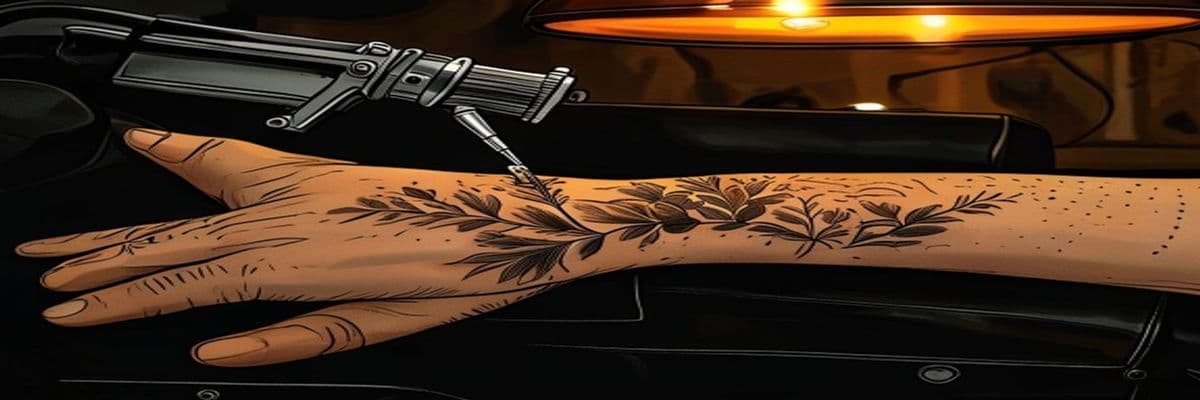
"I'm better than okay," Marcus said. He had a rule about not looking at the work in progress, which I respected enormously. Some clients can't stop craning their necks to see, and then you end up with crooked lines because they've shifted three degrees without knowing it. "I'm thinking about the heat, like you said."
"Good."
"Thinking about the first time I walked a second line. I was seven. My uncle pulled me into the crowd and I just." He paused. "I lost myself in it. Tuba coming up from underneath, shaking the concrete. Trumpet cutting through everything else."
The needle moved. I let his voice become background the way I let Trombone Shorty become background: something to work against, a low rhythm. Today I had the Backatown album on the shop speakers, turned down low enough that it was barely more than texture, that hard-rock-and-funk sound Trombone Shorty does, where the brass instruments stop being polite and start being something closer to urgent. It was the right temperature for what I was building on Marcus's shoulder.
Meridian Ink is a shotgun house on a corner in the Bywater, which means it's long and narrow and the afternoon light comes through the front windows and goes golden and thick before it reaches the back room. That golden light is why I do my best work in the afternoons. It catches the ink differently, shows me what I'm putting down with an honesty that the fluorescent overheads don't. I'd repainted the walls twice since I took over the shop four years ago. First a warm cream, then a deeper ivory when the cream made the flash art look washed out. The flash covered every surface: original designs, six or seven years' worth, framed and arranged in rough rows. Magnolia clusters. Cypress knees rising from dark water. Herons, cranes, the occasional alligator rendered in a precise Art Nouveau line. New Orleans flora and fauna and the specific geometry of iron lacing on balconies. Tourists came in for the tourist tattoos; the regulars came in because they recognised something of the city in my work, and they wanted to wear it.
The cypress floors were the original ones. Forty, maybe fifty years old, stained dark from age and ink and the occasional spilled coffee. They creaked in three specific spots: near the front door, under the client chair, and by the sterilisation station in the back. I knew which spots. After four years, I'd stopped hearing them.
"You ever walked a second line?" Marcus asked.
"Born Treme," I said. "That's all I need to say."
He laughed, and I felt the movement come up through my hand before I could compensate for it. Not enough to pull the line, but enough. I waited a breath.
"Stay still, cher."
"My apologies, Miss Beaumont."
I smiled at his shoulder. "Soleil. We've been through this."
What I knew, professionally, about second line tattoos: the challenge is in the figures. They're small, they're active, they're full of individual character. No second line figure stands the same as another because no second line dancer moves the same way. If you draw them all posed, you get a frieze. What you want is a procession that looks like it's about to make noise. The trick is in the weight, where the foot lands, where the hip breaks, the position of the elbow when the musician blows. I'd spent two evenings studying reference photos before I sketched this one. The trumpet player at the front of Marcus's procession had his horn up at the thirty-degree angle I'd seen in a photograph of a Treme second line from several years back, that particular moment when the bell of the horn is aimed at the horizon and the sound goes forward rather than up, carrying down the block before it lifts.
I thought, not for the first time, that this was what I loved about this work. The way it required you to understand a thing before you could make it permanent.
Three more hours. The light shifted from gold to amber. Marcus fell into the meditative quiet that the best clients find, some deep place inside themselves where the pain becomes something else, not nothing but manageable, a sensation with edges rather than one that overwhelms. I worked through the crowd figures and into the foreground, the grand marshal's silhouette taking shape in the centre of the composition, his hat, the angle of his feathered fan.
When I set down the needle for the clean-up phase, the room felt different in the way rooms feel after concentrated effort: a little depleted, a little more real.
"Let me get the wrap started and then you can look."
"I want to see it first."
I handed him the standing mirror. He took it and held it up so he could see over his shoulder at the hand mirror fixed to the wall, and I watched his face do what faces do when you've done your job right: it opened. Something came up through the professional musician composure, through the studied cool. His jaw moved without producing sound.
"Soleil."
"Mm."
"This is." He stopped. Started again. "I can't." Another stop. "I can hear it."
"That's the point."
He flexed his shoulder experimentally, slowly, a controlled ripple of the deltoid. Checking the give of the fresh ink, that tightened-skin feeling of new work. The second line figures moved with the flex, with the natural topography of the muscle, the way figures always move on living skin.
And then they didn't stop.
It was less than a second. Less than a blink. The procession on Marcus's shoulder had been mid-stride on the left side, the figures leaning forward into motion. And then, just at the periphery of what I was watching, the trumpet player at the front lifted his horn from its thirty-degree angle to something steeper, something more vertical, the horn aimed up at the ceiling.
I looked. The trumpet player was at thirty degrees.
I looked again. The trumpet player was at thirty degrees. Had been at thirty degrees since I drew him. Would be at thirty degrees forever, or until Marcus died and the skin dissolved with him, which was a thought I habitually didn't have about my work.
"You good?" Marcus asked, watching my face now instead of the mirror.
"Trick of the light," I said. "You got good shoulder planes for this piece. Creates some visual movement when you flex." I smiled. I meant it. I was also still seeing, behind my closed mouth and steady hands, the trumpet player lifting his horn. The specific angle of the elbow. The slight turn of the wrist. "Let me get that wrap on. You want to book a touch-up in six weeks?"
He booked the touch-up.
He paid, tipped generously (jazz musicians either don't tip or over-tip, there's no middle ground), and took his aftercare sheet and the little jar of unscented lotion I keep behind the counter for clients who forget to prepare. At the door he paused, hand on the frame.
"You hear Trombone Shorty's new record?"
"That's what's been on all afternoon."
"Good choice." He stepped onto the front stoop. The late afternoon light caught him and he squinted into it, a man with fresh ink feeling the autumn air on new skin, which has a particular quality to it: heightened, raw, the world reaching in through new openings. "See you in six weeks, Miss Soleil."
"Soleil," I said.
He left.
I stood at the front window and watched him turn the corner onto the side street, watched the last afternoon light go orange against the shotgun house facades across the road, all that vivid Bywater colour. Dusty rose, sulphur yellow, a particular shade of teal that appears on about one in three houses down here, the city's unofficial pigment. Wrought iron on the galleries. A jasmine vine thick on the fence next door, mostly brown now in the autumn, the last few flowers going the white-yellow of old paper. Someone, two houses down, had painted a saint mural on their exterior wall, the saint twelve feet tall in cobalt robes with gold leaf detail that caught the setting sun. I noticed the gold was flaking at the halo.
I noticed things. It was my condition.
I went back to the client chair and began breaking down the station. Ink caps into the trash. Tubes into the sharps container. The needle, a nine-round magnum for the shading work, I held for a moment before disposal, the way I always do with a needle that's done something I'm proud of. Acknowledging the work. Then in the sharps container.
My right hand tingled.
Not the familiar ache of several hours' repetitive fine motion. Different. Like the hand had been asleep and was waking up wrong, all pins and static, but localised to the geometric design on the back of my hand rather than distributed across the palm the way muscle fatigue sits. I'd had that geometric design for ten years. Drew it myself at seventeen in a fugue state I still couldn't fully account for. Three nights in a row I'd dreamed about it, and on the fourth night I'd woken at 2 AM with Mamie's old machine in my hand and the design already half-done on my skin, working by memory or instinct or something that didn't have a better word. My mother had not been pleased. The design itself was something between a compass rose and a star chart and neither of those things exactly: interlocking geometric shapes, six-sided, going from the base of my middle finger to the ridge of my wrist. Precise. Clean. Like I'd copied it from somewhere rather than invented it.
I turned my hand over under the shop light.
The design was darker.
Not darker the way new ink is darker. The original work had fully healed a decade ago, settled into the warm tonal range that dark ink settles into against brown skin, a depth rather than a surface colour. This was the way something looked when someone had gone back over the lines with fresh ink. Sharper. More defined. As if, at some point in the last several hours, the lines had been retraced by a steadier hand than mine.
I looked at it for a long time.
Then I cleaned the station and turned up the Trombone Shorty and refused to think about it.
My phone buzzed at ten past nine. I was upstairs in my apartment, which sits above the shop, and I had my feet up on the coffee table with a sketchbook in my lap, working on a design concept for next week's bookings. Not a client piece: a personal drawing, the kind I do to keep the other part of my brain in motion, the part that doesn't take commissions. I'd been drawing a heron for twenty minutes. It kept coming out wrong. The neck curve wasn't landing right.
Marcus Delacroix. Calling, not texting, which was unusual.
"Hey," I said.
"Soleil." His voice was strange. Careful. "I need to ask you something and I need you not to think I'm losing my mind."
"Go ahead."
"My shoulder. The tattoo."
"What about it?"
A pause. In the background I could hear his apartment, the particular quality of New Orleans apartment quiet, which is never fully quiet, always some distance-filtered music, someone else's television, the city breathing through the walls. "It's warm. Not the healing kind. I've had tattoos heal before. This is different. It's warm like." He searched for the word. "Like there's a lamp inside the skin. And the trumpet player."
I stopped looking at my sketchbook. "What about him."
"He's facing a different direction than when you drew him."
In the shop, three floors of nothing below me, Trombone Shorty was still going on the speakers I'd forgotten to turn off. The brass came up through the cypress floors, faint, rhythmic.
"Marcus. New ink does strange things in the first twenty-four hours. The healing process can create subtle visual changes, swelling shifts the composition. I've had clients swear their tattoos look different in the first week."
"His horn is vertical. You drew him at a horizontal angle."
I had drawn him at thirty degrees. Not horizontal. But I'd seen the horn go vertical, for less than a second, and I knew what thirty degrees looked like on a trumpet player in a second line procession because I'd spent two evenings staring at reference photos, and what Marcus was describing was precisely the thing I had not said out loud.
"It's normal healing," I said. "Stay out of the sun, keep it moisturised. You have my number if anything looks infected."
After I hung up, I sat looking at my own hands.
The tingling in my right hand had subsided. The geometric design sat on my skin the same way it always had, except it didn't, except the lines were darker and sharper and I had been staring at my own hand for ten years and I knew what it looked like and that was not what it looked like.
I picked up the sketchbook. Put it down. Picked it up again. Drew three lines of the heron and stopped because the neck was still coming out wrong and it was coming out wrong because my hand was buzzing with something that wasn't fatigue and wasn't fear and wasn't anything I had a word for yet.
The woman came in for a consultation the following afternoon.
I almost didn't notice her at first, which was unusual, because I notice everyone who comes through the door. It's professional habit, the immediate assessment: where they're carrying tension, what their body language tells me about their pain tolerance, whether they've come in ready or whether they need to talk for twenty minutes before they can sit in the chair. I clock people the way other people clock the weather.
She was standing at the flash wall near the door when I came out from the back room, and my first thought was that she was wrong for the Bywater the way a magnolia corsage would be wrong on a work jacket. Too careful, too composed. The Bywater at two in the afternoon ran to art-school casual, to the particular New Orleans combination of heat-wilted and stylish, people who dress with creativity and wear their choices like they make them fresh every morning. This woman was wearing a white linen dress that had no relationship to the season or the neighbourhood, immaculate in a way that suggested it had been ironed that morning and had not been touched by the humidity since. Her hair was pinned. Her hands, at her sides, were still.
She looked to be in her early fifties, though there was something about her that made me not entirely trust that assessment. Pale skin, the kind that comes from either genetics or avoidance of sun. She was studying my flash art with an expression I couldn't read. Not admiring, not evaluating. Something closer to recognition.
"Can I help you?"
She turned. Her eyes were a light grey that photographs probably turned blue.
"I'd like a consultation," she said. "For a design on my wrist. A thorn pattern."
I stepped behind the counter and pulled up my booking tablet. "I can do a consultation right now if you have time. Do you have a reference image?"
"The design I want is specific." She came to the counter, and I caught her scent: something old, something floral but not sweet, like gardenias pressed for a very long time and kept in a drawer. "A thorn branch, wrapping around the wrist completely. No leaves. The thorns angled downward."
"What ink are you thinking? Black and grey? Colour?"
"Black." She looked at my hand, the right hand, the geometric design, and her expression shifted by a degree so small I almost missed it. "Your linework is very precise."
"Thank you."
"I've heard good things about this shop."
"We've been open four years."
"Yes." Something in the way she said it suggested four years was not a long time for a thing she was measuring. She turned slightly and looked around the shop, the whole of it, the cypress floors and the flash walls and the back-room doorway with the velvet curtain I'd hung to give clients privacy. "I have a quote for the price."
"I charge by the hour for detailed wrist work, usually two to three hours depending on the complexity of the thorn placement. I'd want to sketch it first."
"Mamie never charged for this kind of work."
The name landed in my chest the way a stone lands in still water. Not loud. Just a weight, and then the rings spreading out.
"I'm sorry?"
She was already moving toward the door. Not rushing. Moving, with the deliberate unhurried quality of someone who has been ending conversations for a very long time. Her hand was on the door frame.
"Tell her I'll be back," she said, without turning. "When the time is right."
"She's been dead for twenty-two years," I said.
The door was already closing, and the jasmine vine outside stirred in the absence of wind, and the bells on the door handle (little brass bells, Mamie's installation, which I'd kept because I liked the sound) rang twice and went still.
I stood behind the counter for a while.
On the speakers, Trombone Shorty had shifted to something slower, the horn working a line that went under the percussion rather than over it, intimate and low. The afternoon light was doing what it does in late autumn, going amber earlier than it should, catching the dust motes in the front window.
I looked down at my right hand.
The geometric design looked back.
I close up at seven on weekdays, unless I've got a late sitting, and that Tuesday I had nothing booked after five. I wiped down the stations, swept the cypress floor, took the trash out to the bins in the side alley, and was carrying the mop back inside when I almost stepped on it.
A raven. Dead on the front doorstep, laid with its wings fully extended, spread wide on the boards, the way a taxidermist would arrange a specimen for display. It had not died there. A bird that dies from natural causes folds inward, collapses into itself. This bird had been placed. Its feathers were glossy and undamaged, which meant it had not hit a window or a car. Its eyes were closed, which was wrong for a dead bird in a way that was specific and deliberate: birds don't close their eyes when they die any more than fish do.
I stood over it for a long time.
On the concrete beneath the bird, drawn in what looked like black ink, was a symbol I did not recognise. Geometric. Six-sided, with interior lines that suggested a compass design, though not any compass rose I'd seen in a reference library or a client consultation. The ink on the concrete was fully dry and had no smell, which meant it had not been done recently, and yet I had swept this stoop that morning.
I photographed it. Both the bird and the symbol. I stood and looked at the symbol and turned my right hand over and held it above the drawing, the geometric design on my skin parallel to the design on the concrete.
Different. Clearly different. And yet they shared a logic. The same internal structure, the same ratio of interior space to line, the same quality of having been drawn by someone who understood what they were encoding rather than what it would look like.
I put the raven in a box from the supply room, the kind I use to ship prints, and set it aside. I scrubbed the concrete with the mop. The ink didn't come up. Not unusual; some inks bond aggressively with porous surfaces. I scrubbed harder. Still there, faint but present, the ghost of the symbol under the soapy water.
I locked up, front and back, and went upstairs.
For a while I sat on my bed in the dark and thought about the trumpet player lifting his horn.
Sleep, when it came, came quick and with the quality of falling.
I was in the shop. Not the upstairs apartment but the ground floor, the back room, the client chair positioned the way I'd positioned it that morning. The cypress floor was the right floor, the same three creaking boards, the flash art on the walls the same flash art I'd been living with for four years. Except it was different in the way things are different in dreams: the same and not the same simultaneously, the magnolia clusters darker, the herons watching me from the paper instead of sitting in profile.
There was a man in the chair.
I knew I didn't know him. Dream logic insisted on this the way it insists on certainties: I had never seen this man before and yet I was tattooing him with the familiarity of a long-term client, with my needle already going, already mid-line on the inside of his left forearm.
He was pale. Not the Bywater's usual range of pale, not the pallor of someone who worked indoors, but a depth of paleness that made the veins on his forearm visible as blue roads under the skin. Dark hair, slightly wavy, touching his collar in the back. He had a sharp face, angles that a portrait painter would love and a portraitist would need three sessions to capture correctly. He was wearing a black shirt with the sleeves pushed up, and his arms were covered in tattoos. Not mine, not anyone I recognised. Old work, faded and greying, the kind of work that had healed twenty or thirty years ago and been carried since. The designs were geometric, symbol-heavy, the same internal logic as the work on my right hand.
His eyes were closed.
My needle was moving on his forearm and I was drawing something I had never designed, had never conceived, had never seen in any reference material. A door. Not a decorative door, not the New Orleans ironwork gate that would have been the natural thing, not the kind of door that made a good tattoo. A functional door, drawn with the economy of technical illustration: four lines, a threshold, a handle, hinges, a keyhole. The door was small on the skin of his forearm, contained to a space the size of a matchbox. But when the needle finished the final line, the door was done, and the door was present, and the door opened.
Not in the tattoo. Not on his skin. In the room.
The wall across from the client chair opened like a door and something was on the other side and it was looking at me.
I did not see what it was. The dream did not let me. Only the awareness of it: vast and specific, the quality of being seen by something that understood what it was seeing. The way an animal understands it's being studied, not with paranoia but with accuracy.
My needle stopped.
My hand was on fire.
I woke up screaming. Not a long scream: a short one, cut off by the ceiling of my own bedroom above me and the familiar dark of my own apartment, the grey early light coming under the curtains, the sounds of the Bywater outside my window, a car engine somewhere, the first birds.
My right hand.
I was holding a tattoo needle.
Not one of my working needles, not a needle from the station downstairs, not a disposable one from the box on the counter. This was one of Mamie's old needles, the ones I kept in the locked cabinet in the back room because they were forty years old and no longer sterile but too important to dispose of. The locked cabinet. Which I had not opened since I restocked two months ago.
I sat in my bed and held the needle in the light from the gap in the curtains, turning it in my fingers.
My palm was still burning.
I got up. I went downstairs in bare feet, through the door that connected my apartment to the shop, feeling each step on the old cypress, my breath the only sound. The shop was dark and quiet, the way it is in the hour before the city properly wakes, everything in its place, the flash art on the walls visible in the street-light seeping through the front windows.
The back room cabinet stood under the small window on the east wall, the way it always did. Original cypress, same as the floors. Mamie's. I'd painted it twice and the paint had gone uneven, tracking the old grain. The lock was a simple mechanism, keyed, and the key lived on my keychain.
The lock was engaged.
I tried the door. It did not move.
I put the needle against my palm and looked at the locked door of the cabinet and the needle was in my hand and the cabinet was locked and I had been upstairs in my apartment and I had not come down here.
The geometric design on my right hand burned like a brand.
In the front room, barely audible through the wall, my speakers had turned themselves on. Trombone Shorty, the slow track from the end of the album, horn low and deliberate, working a line that went nowhere fast but arrived exactly where it meant to arrive.
I stood in Mamie's back room with her needle in my hand, and the Bywater woke up around me, and I did not have a word for any of it.
Not yet.
What did you think of this chapter?
Drop your thoughts and get notified when new chapters arrive. The author reads every message.
Continue reading
Chapter 2→