The coffee finished brewing at six forty-seven and I had been awake since three.
I know the specific arithmetic of a sleepless night in the Bywater: the hour when the music from the bar three streets over finally cuts off and the silence arrives like water filling a space, the hour when the neighbourhood cats start their business on the fences, the slow grey pre-light that turns the windows into pale rectangles before the sun does anything useful with them. I had catalogued all of it from my couch, feet up on the old armrest, the ceiling fan barely moving overhead, Mamie's cedar needle box on the kitchen table where I'd left it after I came back upstairs from the shop. I had not opened the box. I had looked at it for approximately four hours.
The coffee was hot and I needed it and I was not going to think about the cabinet that had been locked, or the needle that had been inside it, or my hand that had burned in the night.
I thought about all three things while I drank my coffee.
The question that kept surfacing, the one I couldn't drink past, was simpler than the others: how does a man know that the tattoo he watched you make moved? How does a man say I was in the procession and mean it as a statement of fact and not a metaphor? What does that imply about everything Mamie ever told me about her work, and about what I had inherited from her, and about the four years I had spent telling myself that the way my ink landed on people was craft and patience and nothing stranger than that?
I texted Odette Fontenot at seven-fifteen. I'm coming this morning. Bringing coffee and beignets. Anything Mamie needs?
Odette texted back fast, which meant she'd been up for a while. Just yourself, cher. She's been asking after you. Then, a short pause, another message: She had a bad night.
I got dressed, put on the good earrings, the ones Mamie gave me for my twenty-fifth birthday, two small gold discs with a sunburst stamped into them, New Orleans craft from a jeweller on Magazine who had since moved away. The kind of thing you wear when you're going to see someone who is going to read your face and you want to give her something good to read.
The woman at the Cafe Du Monde counter recognised me by my order and was already reaching for the bag before I stepped up to the window. Early October morning, the river breeze still carrying a small residual warmth rather than the coming cold, the light on the levee the colour of weak tea. The tourists who were already out looked like people who had been promised something and were waiting to see if it would be delivered.
"These for Mamie?" the counter woman asked.
"Always."
She made the sound that people who know Mamie make when they hear she's still here, still in that chair on the gallery: approval with a note of reverence in it, the particular sound New Orleans makes about its elders, who are the city's real infrastructure.
I carried the tray and the bag to the car and drove to Treme with powdered sugar on my fingers and the beignets already warm against my palm through the paper and the morning light going gold along Esplanade, the live oaks on the neutral ground making their deep tunnel above the street.
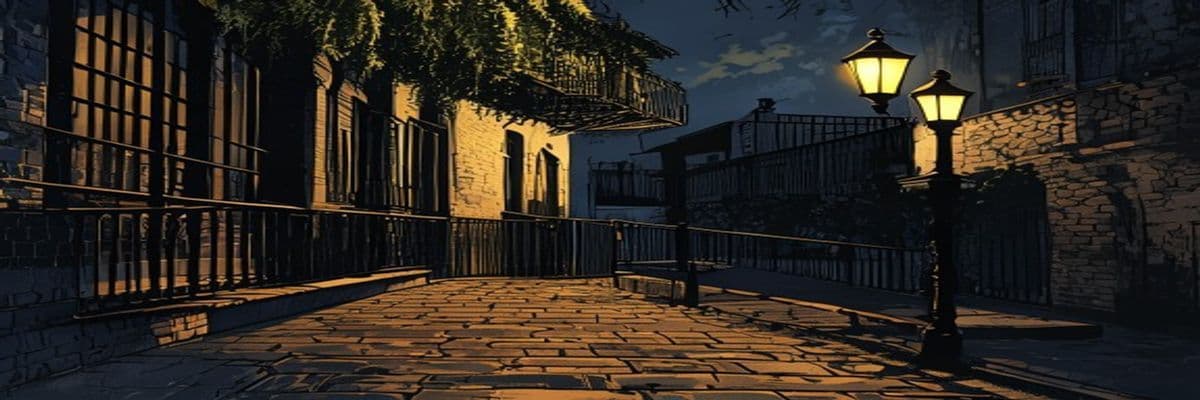
The Bywater is a neighbourhood that found itself recently and is pleased about it, colourful and a little self-aware, art-school energy in the painted cottages and the murals. Treme is something else, something older and less interested in your opinion of it. The houses here sit in their age with the composure of things that know exactly what they are. Double shotguns, mostly, with their deep yards and their gallery ironwork, the iron lace original in a lot of cases, cast in the nineteenth century for a city that understood iron as decoration the way it understood music as necessity.
The double shotgun on St. Bernard Avenue had two live oaks in the front yard that had been lifting the sidewalk for as long as I could remember. The left side of the house was occupied, the right closed off since Mamie's last tenants left eight years back. The gallery iron ran unbroken across the full front, fine as lace and original to the cast, recently repainted that specific dark olive green that Mamie had used twice in my lifetime and would not be talked out of.
She was on the gallery. Old wooden rocker, her mother's before it was hers. Blue blanket on her lap even in the October warmth, which was one of the things the doctors mentioned and one of the things they didn't mention that said more.
She raised one hand when she saw the Cafe Du Monde bag.
I climbed the steps and kissed her forehead and put the coffee on the side table and the beignets in her lap still in the bag so the heat would hold. Her forehead was cool under my lips. Her cheek against mine when she turned carried the scent she had always carried: Tres Flores brilliantine in the grey hair, and underneath that the deep cedar-and-magnolia smell of the house, fifty years of accumulated presence.
"You look tired," she said.
"Didn't sleep."
"I know." She pulled a beignet from the bag with the deliberate care she used for everything now, hands that hurt in the mornings not admitting it. Her hands. I had looked at Mamie's hands my whole life the way you look at an instrument in the hands of a master, with the awareness that what you're watching is the visible part of something much larger and mostly interior. The tattoos covered everything: backs and palms and each finger, a continuous text in the old style, plants and symbols and lines of what might have been script in a language I had never fully learned. Forty years of her own work on her own body, renewed and added to across decades.
The tattoos on her left forearm were lighter.
Not faded in the way old ink fades, the soft blur of decades-old lines as the skin thins and the pigment migrates outward at the edges. This was specific and wrong. The magnolia vine that climbed from her wrist to her elbow, a piece she had done on herself thirty years back that had always been among the sharpest work on her body, was lighter as if something had been drawing the colour up and away, leaving the ghost of the design: outline present but pale, fill washed out.
She was watching me look.
"They're lighter," I said.
"Yes."
"How long."
"The forearms started in July. The upper arms are still holding." She broke off a piece of beignet with her thumb and ate it, dusted her fingers on the edge of the bag. "The ones on my chest are fine. The old pieces are fine. The work from the last fifteen years is going first."
"That's not normal fading."
"No." She said it simply. Fact, not fear. "It isn't."
The morning held us a moment, the live oaks moving in the small river wind, the gallery iron throwing its regular pattern of shadows across the boards at our feet.
"Mamie."
"Soleil."
"The boy came," I said. "Didn't he. The warden."
She turned and looked at me without surprise, without the small performance of someone who had not been expecting this. She had been expecting it. Possibly for some time.
"Tell me what he looks like," she said.
"Tall. Pale. Dark coat. He speaks like someone who learned English from a library and then spent a long time in the city updating it."
She made a sound that was not quite a laugh. "Cold eyes?"
"Careful eyes."
"That's what they all say at first." She looked out at St. Bernard Avenue, at the live oaks and the lifted sidewalk and a neighbour's boy walking a dog that was too big for him, the dog leading the walk. "I knew his predecessor. A warden named Celeste, before him. She came to me once, must have been twenty-five, thirty years ago. Different face. Same cold eyes. The work does something to a person over time, I think. Settles the eyes."
"He said he was in the procession," I said. "The tattoo I put on Marcus Delacroix's shoulder. The second line. He said he was in the spirit version of it when it moved. He said that is where he came from."
"I know what the Veiled City is."
"I know you know." I set my coffee down. The words I had been arranging all morning finally came to the surface in the order they needed to be in. "You knew about all of this. The work I've been doing. The way it lands. The things it does. You knew and you didn't tell me, and I need to understand why."
She was quiet for a moment. A long moment, long enough to be deliberate. "I told you everything I had the time and the health to tell you," she said. "And you needed to come to the rest yourself, in your own season, or it wouldn't hold." She looked at her forearm, ran a thumb along the pale magnolia vine. "What I can tell you now: every piece you've put on someone in the last year has been lit. Not dangerous in itself, but visible to things that take notice. You've been working without any covering, any buffer, any protection for yourself or the people you've marked. And something out there has been watching your work for six, seven months. You lit up and it noticed, and it has been moving closer since."
"What do you mean, moving closer."
"I mean it has stopped watching and started acting." She said this flatly. "And my tattoos are fading. And a warden has come to your shop. Those three things are the same event." She looked at me steadily, the warm oak eyes I had known all my life. "What did you do with the warden, Soleil. When he came."
"I told him to leave."
"And this morning you're at my house before eight with beignets and you look like the inside of a sleepless night."
"I told him to come back," I said. "I didn't say when."
She nodded. Picked up her coffee, sipped it. The sun was clearing the roofline of the house across the street and the gallery was going warm and gold around us, and I thought that this was what I always wanted when I came here: this specific light, this specific smell, this woman in this chair, the knowledge that she was still in the world, that the city still had her in it.
I sat for a moment with that, the morning wrapping itself around us, the iron shadows moving as the live oaks shifted in the river wind. I was thinking about the specific phrasing. Something out there has been watching your work. Not watching me. Watching the work. As if the work were a signal separate from the person making it, a transmission I had been broadcasting without knowing I had a transmitter.
That was not a comfortable thought.
"The protections," I said. "The ones you used to have. The ones I don't. What are they, technically? What do they look like in practice?"
Mamie set her coffee cup down. She looked at her right hand, turned it palm-up, where a small geometric design sat at the base of her thumb, a single form, simple, a circle with an interior cross that was also a compass rose if you knew to look for it. She had put it there herself, she'd told me once, the night before she opened the shop for the first time. She called it her door-closing mark. She had never explained what the door was.
"You cover your work," she said. "Not the clients' pieces. Those are covered inherently if they're made well, because good Ink work carries its own weight and settles in the skin in a way that doesn't announce itself. I mean your tools, your space, your own skin." She gestured at the shop I'd grown up in. "This house has thirty years of marks in it. In the walls, the floors. Some of them you can see if you look. Some I put under the paint when I repainted the gallery. They function as filters. They let the right things in and make the wrong things uninterested in visiting." She looked at me. "Your shop has nothing like that."
"I live above the shop."
"I know."
"So whatever has been watching my work has been watching my home."
"Yes." She said it without flinching. "For six months, by my estimate. Which is also roughly when my own marks started fading."
I felt that connection form, clean and cold, in the back of my mind. The fading of Mamie's protections, the thing noticing my work, the timing. Not coincidence. A sequence.
"Something weakened your marks first," I said. "And then, when your marks weakened, my work became more visible. Like someone turned down the interfering signal."
Mamie looked at me for a long time. "You are faster than I was at your age," she said. "I don't know whether to be glad about that."
"Be glad," I said. "We don't have time for slow."
My phone rang.
"Sol." Yoli's voice on the other end had a particular quality, the professional register she uses over a personal line when what she has to tell me is not going to be easy. I had known Yolanda Tureaud since ninth-grade French class, which we had both failed in a cooperative spirit, and I knew all her registers. This one was the careful one. The one that preceded difficult facts. "Are you busy."
"I'm at Mamie's."
"Okay." A breath. "I need you to come look at something. Not at your shop. I need you to come to the morgue."
Mamie had not moved. She was watching me with the expression she wears when she has been expecting a phone call too.
"What happened," I said.
"A man came in last night. They found him in the Marigny, off Kerlerec Street, in the alley. No ID on him. Hotel key puts him at one of the Frenchmen Street hotels, checking in three days ago. Tourist, Sol. Middle-aged, looks like somewhere without this heat. And he has marks."
"What kind of marks."
"That's why I need you." Yoli had been with NOPD for eight years. She had developed the professional capacity to hold distance from what she described. But something in the care she was taking with her words told me the distance was costing her. "They look like tattoos. The hotel clerk saw him three days ago. No visible tattoos. This morning, when they brought him in, marks cover his chest, forearms, neck. And they show." A pause. "Sol, they show the man drowning. In a flooded street. The images are clear. It's a composition, a death portrait, and someone or something put it on this man's skin. I need your professional eyes on it. Your technical read. Can you come?"
I looked at Mamie. She nodded once, very small.
"I'll be there in an hour," I said.
The Orleans Parish morgue on South Galvez announces nothing. It sits in the flat light with the composure of a place that has no reason to be anything other than what it is. Yoli met me at the side entrance in her dark jacket and white shirt, her twist-out winning its ongoing argument with the October humidity. She squeezed my hand once before she led me in.
"I need your technical read," she said, walking. "Whatever you see in the marks, whatever they tell you about who or what made them. Treat it like an expert consultation."
"What do you already know?"
"Almost nothing. No cause of death yet. Preliminary is cardiac or anoxia, but the ME hasn't found a mechanism. No trauma. He died without anything that shows." She pushed through a door. The cold took over from the building's baseline temperature, the specific held-cold of a controlled room, deliberate against its environment. "Forty-three years old, based on the hotel paperwork. First-time visitor. No prior record, no known associates in the city."
The room. The table. The man under the overhead light, the sheet folded to his waist.
I stepped closer.
The marks were precise. That was the first thing, and it settled in my chest like a weight. Too precise. I have been tattooing for fifteen years. I spent seven years before my formal apprenticeship learning under Mamie, and since then I have looked at hundreds of other tattooists' work across every skill level, every style, every tradition the city carries, and I know what the hand does when it makes a line on living skin. Even the best hands in the world leave themselves behind: a micro-tremor absorbed, slight variation in the pressure as the needle moves through the varying densities of the dermis, the small evidence of a living instrument meeting living material. No two lines of tattoo ink sit identically because no two moments of making ink are identical.
These lines had no variation.
The line on the forearm closest to me showed a man standing waist-deep in water on a flooded street, building facades half-submerged on either side, a stop sign showing red above the water line. The composition was clear and specific and cold. The lines describing the water were even throughout their entire length, even through the curves, even at the corners where a living hand always, without exception, shifts its pressure fractionally as it changes direction. The figure of the man in the water was rendered with the economy of technical illustration rather than artistic intention: present, accurate, depersonalised. Without warmth. Without the small choices a human artist makes when they care what they're making.
The neck piece was the hardest to look at. It covered the whole anterior surface of the neck from the clavicle to the jaw, and the image it showed was the same flooded street from a different vantage point: looking up from below the surface. The waterline visible. A sky of churning water. The man drowning from inside the drowning, the image made from his own final perspective. Someone had stood over this man and drawn his death from the inside.
I made myself look at it the way I look at any work I need to understand professionally: systematically, moving the eye from line to line, reading the intention in the mark. There was intention. This was not violence that happened to look like craft. This was craft that had chosen violence as its subject and rendered it with the care the best artists bring to anything they consider worth making permanent.
I looked at the chest piece. The neck piece. I moved around the table slowly, looking at each composition.
"Well," Yoli said, behind me.
"The line work." I straightened. "There's no variation. No micro-tremor. No evidence of a living hand anywhere in these marks. This is not tattooing the way I know it, the way any human tattooist works. But it is in the skin. The ink is in the dermis, distributed the way real tattoo ink distributes. Something went into this man's skin and made these marks and left no trace of a human instrument."
"Can you say what did make them?"
"Not yet." I went back to the forearm. Looked at the flooded street again. The level of the inundation, the specific way the water sat at the door-frame height of the buildings, the architectural style of the facades, late-nineteenth-century French Quarter. The angle of the light implied a late afternoon in September. "This is Katrina flooding," I said. "This water level. These buildings. Whatever made these marks used the 2005 flood as the setting for his death portrait. A man who had never been here until three days ago, and something used the worst event in this city's recent history as the image of how he died." I put my hands in my pockets. "Was there anything else? On his hands, his feet, any wound site that might be an entry point?"
"Nothing."
"Yoli." I kept my voice even. "Has anyone else come in like this in the last month?"
The brief silence told me what her words would tell me. "I can't discuss an open investigation."
"That means yes."
She did not correct me.
The light outside was the flat white of mid-morning, the kind that holds no shadow and makes everything look slightly temporary. I stood on the sidewalk and breathed outdoor air, the New Orleans compound of exhaust and river sweetness and something edible from the block over. I put my hands in my pockets and looked at the sky, which was offering nothing in the way of guidance.
He was ten feet down the wall to my right.
Leaning against the building with a white paper bag from somewhere, eating a shrimp po'boy with the unhurried attention of someone who had been there for some time and had no particular plan to leave. The dark coat. The dark hair. The quality of stillness around him that wasn't absence of movement but mastery of it.
I walked toward him.
He watched me come. Did not adjust his posture. Did not stop eating.
"Did you know about him," I said.
He finished chewing. Looked at the po'boy, assessing. "The sauce here has been consistent for a long time. That's a rare thing."
"Answer the question."
"That's the third one." He said it flat, without apology or softening. "The man inside. And yes. That is why I'm here."
I stood in front of him in the October light and the city went on around us, a bus at the end of the block, a man on a bicycle, two women carrying bags from somewhere, all of it the ordinary morning of a city that does not know what is happening in one of its refrigerated rooms.
"Three people," I said.
"The first in August. A woman from Texas, staying in the Marigny. Found in her hotel room. The marks on her showed the 1788 fire, the one that took most of the French Quarter. A fire that happened nearly two hundred years before she was born. The second was a man from Atlanta, eight days ago. His marks showed a specific incident from the 1853 yellow fever epidemic. Mass graves on the edge of the city." He looked at the paper bag, folded the top down. "And now a man from somewhere else with Katrina flooding on his skin. Three tourists. Three pieces of the city's worst history used as the medium." A pause. "Whatever is making these marks is using the city's own grief as its ink."
The words sat in the morning air.
"You were watching my work," I said. "Before you came to the shop last night. You'd been watching it."
"For several months. Your work is visible from the Veiled City. It registers the way a lit window registers on a dark street. And you have been working without any protection, for yourself or your clients. Whatever is moving through the city noticed you long before I came to your door." He looked at me steadily. "I don't know yet whether it sees you as a resource or a target. I'm trying to determine that before the question becomes urgent."
"That's a polite way to say I might be in danger."
"Yes."
I looked down the street. The bus was gone. The ordinary morning was very ordinary, very persistent in its ordinariness, the city offering no acknowledgement of what was happening inside it or to it or to me specifically, standing on a sidewalk outside the parish morgue having a conversation about dead tourists and spirit cartography.
"What would it take," I said. Slowly. Feeling the words as I said them. "To work together. To figure out what this is."
"At minimum: you come into the Veiled City once, with me. So you can see the marks from the other side, where they're fully present. Understand what you're dealing with at its actual scale." He paused. "Beyond that, it depends on what we find."
"You're asking me to step back into something I walked away from."
"Yes."
"I had reasons for walking away."
"I assumed you did." He didn't ask what they were. He offered no reassurance, no argument, no persuasion. He simply waited, which was its own kind of pressure and also not pressure at all, and I was not going to think about the particular quality of that patience right now, in the October morning, outside the building that contained three people's worst last hours.
Three people. Three pieces of the city's grief on their skin, put there by something that worked without a human hand.
Mamie's tattoos fading. The warden's predecessor. Whatever had been watching my work for months and had now started doing more than watching.
"You have until I change my mind," I said. "Whatever arrangement this is, whatever we're doing. That is the condition. I change my mind, it ends. No debate, no renegotiation."
Something moved in his face. Small. In the corners of the eyes before it reached the mouth, and it barely reached the mouth. "That's more than the last one gave me," he said.
I looked at him. The morning sat in the narrow space between us.
"Who was the last one," I said.
He didn't answer. He looked past me, down the street, toward the river that was somewhere behind the buildings, out of sight but present the way the river is always present in this city, by smell and by the particular quality of the light it throws off a horizontal surface. His expression went somewhere I could not follow: flat, and old, and private, the expression of a man reaching toward something at a distance that had not closed in a very long time.
He folded the paper bag in his hands. He held it. He did not answer.
The question stayed between us, unanswered, and I filed it in the part of my mind where I put the things I was going to come back to. The three dead. The marks with no human hand behind them. Mamie's fading forearms. The needle in the locked cabinet. All of it gathered in a category I didn't have a name for yet, a category that was growing, and I was standing outside a morgue in October with a man who had been in a spirit procession on Marcus Delacroix's shoulder, and the city moved around us, and whatever was making death portraits out of New Orleans grief was still somewhere inside it.
What did you think of this chapter?
Drop your thoughts and get notified when new chapters arrive. The author reads every message.
Continue reading
Chapter 3→