The blazer had four buttons when I bought it. Charity shop, three pounds fifty, navy blue with brass fittings that I'd polished the night before with a corner of kitchen towel. I noticed the missing button on the District line somewhere between Embankment and Sloane Square, standing in the crush of Tuesday morning commuters, portfolio tucked under one arm and my phone in the other hand showing me the address for the twelfth time. Bottom button. Gone. Just a loose thread where it should have been, and a small round absence that would be the first thing Robert Hale (estate manager, retired military, according to the listing) would see when he opened the door.
I tugged the blazer closed and held it there with my arm across my portfolio. Pressed my back against the door as the train pulled into Sloane Square. The platform tiles were cream and burgundy, scuffed by thirty years of commuters, and the air coming through the opening doors smelled of hot metal and, faintly, something industrial I'd never been able to name. Not unpleasant. Just underground. The city below the city.
The walk from Sloane Square to the address in Belgravia took eleven minutes. I know because I counted them. Past the square itself with its bare plane trees and the flower stalls doing muted Tuesday trade, past the King's Road junction where a black cab clipped a cyclist and both parties said things I tried not to hear, and then left onto quieter streets where the buildings changed character in the way London does: sharply, without negotiation. The Victorian red brick and the noisy patisseries gave way to terraces of white stucco that sat in the grey April morning like something assembled for a film set. Wide facades, painted the colour of old cream. Four and five storeys. Brass fittings, sash windows, window boxes with things growing in them that had been chosen by someone who knew what they were choosing. The pavements were cleaner. The cars were different. Even the birdsong seemed considered, as if the pigeons here had been briefed.
I texted Priya from the corner: at the address. it's a georgian mansion. my blazer is missing a button. send help. She replied with a single word: GO. And then, three seconds later: button irrelevant. you got this. I put my phone away and crossed the street.
I found the address and stood in front of it and thought: of course.
Number 14 was indistinguishable from its neighbours and entirely itself. The same white stucco, the same proportions, the same black iron railings along the basement steps. But the curtains were drawn on every window. Every window except one, narrow, on the second floor, where I could see the edge of something framed on a wall in a dark room. The brass knocker was polished to a high shine and showed no wear from use. The kind of polish that comes from habit and pride, not from visitors. Four stone steps up from the pavement, very clean. The front door was black, glossy, and looked like it had been painted last week. There was no doorbell I could see, just the knocker, and standing in front of it I had the specific sensation of being assessed. By the building. Which was ridiculous.
I used the knocker. Two raps. Stepped back.
The door opened in exactly the time it takes someone who was already in the hallway to open a door.
The man who opened it was about fifty-five, trim, silver-haired, wearing a suit that fit like it had been issued to him. He stood at parade rest without seeming to, and looked at me the way someone looks at a flight schedule. Taking inventory.
"Miss Whitmore," he said. It wasn't a question.
"Yes," I said. "Sorry, yes. Hello."
He opened the door wider. "Robert Hale. Come in, please."
I came in.
Later I would have better words for the entrance hall of Ashford House, because I would spend months in it. But that first morning, walking through the front door of number 14 carrying my charity-shop portfolio and holding my blazer shut with one hand, I had no words at all. The floor was marble in a pale grey, laid in large squares with a darker border, and it ran the length of the hall to a staircase at the far end. The staircase was stone, with wrought iron balusters, and it curved upward with an unhurried confidence that made clear it was not in a hurry to get anywhere. The ceilings were high. The walls were a warm white, not quite ivory, and a series of framed prints ran at eye level on the right side. Pencil studies, I saw, architectural, someone's collection of drawn facades. There was a coat rack that had been there long enough to look permanent, and next to it, an umbrella stand that I clocked as Victorian, probably mahogany, and which had been holding umbrellas long enough to have a slight lean. The light from the single open window fell across the floor in a long pale strip.
And at the far end of the hall, hung above a low console table and lit by a small directional lamp that hadn't been adjusted in some time, was the painting.
I stopped.
Robert Hale stopped behind me. I could feel him waiting, the way you can feel someone's patience as a distinct texture.
The painting was approximately 125 by 100 centimetres. Oil on canvas, dark ground, the background an undifferentiated darkness from which the figures emerged. David stood at three-quarters to the viewer, holding a sword in his right hand, and in his left, raised slightly, the severed head of Goliath hung by the hair. The head was heavy. You could see the weight in the tendons of David's wrist. Goliath's face was turned outward toward the viewer: mouth slightly open, one eye dull, the other retaining that terrible last spark of pigment that Caravaggio had put there to say not quite gone yet. The face was Caravaggio's own. I knew this from my thesis. The face was the artist holding his own severed head and looking out at the people who came to stand in front of him four hundred years later. The light fell on David's forearm, his shoulder, the curve of his bare chest above the dark clothing, and the head, catching the blood still beaded on the cut. Everything else was dark. David's face was in shadow. His expression, what you could see of it, was not triumph. It was something closer to exhaustion. Or grief. The grief of someone who has done a necessary thing and can't pretend it was nothing.
"Is that..." I said, and stopped.
Robert waited.
"Sorry," I said. "I know it's. I'm being unprofessional. But is that real? Is that actually a..."
"Yes," Robert said, from behind me. Dry, neutral, the voice of a man who had watched many people stop breathing in front of this particular painting. "It is."
I stood there for another moment. I was aware that I was meant to be demonstrating composure. I was also aware that there was a Caravaggio eight feet in front of me in a private entrance hall, hung between a Victorian umbrella stand and what I was fairly sure was a Piranesi etching, and that composure was a reasonable thing to sacrifice.
"Mr. Ashford's previous archivist," Robert said, "made a very similar face. She lasted four months." He said this without evident emotion. "Your interview is on the fifth floor. Shall we?"
I tucked my hair behind my ear, which is something I do when I'm nervous, and followed him up the stairs.
The first floor as we passed it was all gallery, professionally lit, climate-controlled to a degree you could feel in the air, a slight hum that I clocked as the HVAC. The walls here were a muted stone grey and the paintings were hung with the considered spacing of a public institution: room between them, room to breathe. Through the open doorway I glimpsed a Dutch interior, small, a woman at a table with a letter, the light falling from an unseen left-hand window. The light was warm. The light in the painting was warm. The light in the actual gallery was cool and calibrated. I wanted to stop. I didn't stop.
The second floor: another gallery, darker scheme, one painting visible as we climbed past the landing: large, dark, very red in the shadows.
The third floor: the door was closed.
The fourth floor: another closed door, this one with a key in the lock.
The fifth floor was the archive.
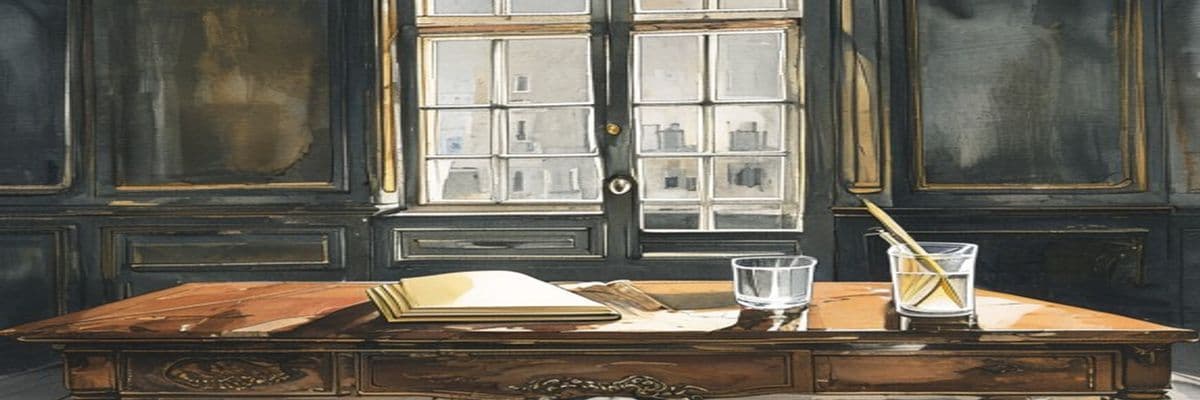
Robert opened the door and I walked through into a different world. Where the galleries below were ordered and precise and curated within an inch of their lives, the fifth floor was chaos. Beautiful chaos. The kind of chaos that means someone has been working. Acid-free boxes, labelled in various handwritings and typed adhesive strips, stacked on metal shelving that ran the length of two walls. A long table down the centre, covered in folders, a magnifying glass, a tray of pencils and a single red pen that had rolled against a box. Two large windows giving onto the street below, both letting in the grey April light without filter. The smell: paper. Old paper, specifically. The particular mustiness of documents that have been stored well but not recently handled, a smell somewhere between library and attic and something faintly mineral that I associated with provenance files and estate sale archives and, inexplicably, home.
I breathed it in.
"Please sit," Robert said, gesturing to the chair at the near end of the table. He cleared a folder from it without ceremony. "Mr. Ashford will be with you shortly. He is punctual."
He left.
I sat down, put my portfolio on the table, opened it to the section on my Courtauld thesis work, and then looked around the room. The labels on the boxes nearest me: Italian, 16th-17th c., acquisition docs. Dutch Golden Age, research files, 2019-2023. Contemporary, mixed, insurance. One box at the end of the top shelf, away from the others, with no label at all. Just a number: 14.
I looked at it for a while. The archive had the feeling of a thing that had been accumulating without being addressed, the way a person's desk does when they're very busy with something else. Not neglect exactly. More like priority. Julian Ashford's priority was clearly elsewhere. What was in the boxes mattered to him; the system for accessing it apparently did not. That was going to be interesting to work with.
I tried not to think about the phrase "work with" and how much I already wanted the job and how much I needed to seem calm about it.
Against the far wall, facing inward, was a painting. Not hung. Propped. Unframed. The canvas was turned to face the wall, so what I could see was the back: old stretcher bars, dark with age, the canvas yellowed and clean. Whatever was on the other side had been put there deliberately. Propped there and left.
I was looking at it when the door opened.
I heard him before I saw him: the specific soft sound of expensive shoes on a wooden floor, unhurried, certain of where they were going. I turned, and Julian Ashford walked into the room, and I did what I do when I'm confronted with a painting I haven't prepared for. I catalogued him.
Tall. Six foot two, maybe more. Dark brown hair with early silver at the temples, and the silver was not sparse or apologetic, it was structural, as if it belonged. Strong jaw, straight nose, cheekbones that suggested someone in his ancestry had sat for Sargent, and Sargent had done his best work. He was wearing a navy suit, beautifully cut, with a white shirt and no tie, and the suit looked like it had been made for him by someone who cared and worn by someone who didn't particularly notice. He was carrying a folder of documents, and his eyes, which were dark blue and which I did not spend any additional time considering, were already on my face.
He stopped at the far end of the table.
"Miss Whitmore," he said.
"Yes," I said, and got to my feet. We shook hands. His hand was warm and dry and his grip was firm and his fingers were long and fine and I noticed none of this at all. "Thank you for seeing me."
He set the folder on the table and sat down opposite me. He didn't say anything for a moment. He had the look of someone who considers silence a form of information, who uses it that way, consciously, to see what people do with gaps.
I pushed my portfolio toward him. "I've brought my thesis chapter and two catalogue essays. The Frick provenance piece and the Amsterdam Golden Age exhibition notes. I don't know what materials you've already seen from my application, so I've tried to..."
"I've read your application," he said. "Several times." He glanced at the portfolio but didn't open it yet. "Your application mentioned Adriaen van de Velde. Specifically, you referenced a Berchem influence in his treatment of landscape figures."
"The 1669 series," I said. "Most people read the pastoral subjects as primary Dutch, but the handling of the figures in the middleground is Italianate in a way that points to Berchem's mentorship. If you look at the spatial recession in..."
"I know the 1669 series," he said. "What I want to know is whether you worked that out from looking, or from someone else's scholarship."
"From looking," I said. "I was writing a paper on Dutch-Italian influence exchanges and I needed a clear example of a Dutch painter who'd absorbed the Italianate tradition from within Amsterdam rather than from travel. Van de Velde was in the collection at the Rijksmuseum at the time. I stood in front of it for forty minutes."
Julian Ashford opened my portfolio.
He read in silence. He read the way people eat when they're genuinely hungry: steadily, without looking up, with his full attention. The only sound in the room was the faint traffic from the street below and, once, a pigeon that landed on the window ledge and then left.
"Your provenance essay," he said, still reading. "You identified a gap in the documentation for the Frick's Vermeer."
"The 1911 sale record has a three-month gap between the Amsterdam dealer and the New York acquisition. The standard scholarship assumes a direct transaction but the correspondence files I accessed through the Frick archive show two intermediary transactions, one in Paris, one in London. Which matters because one of the London parties was active in the wartime market and the paintings that passed through his hands in the forties need re-examination." I paused. "Sorry. That was a lot. I can..."
"Don't apologise," he said, still reading.
I closed my mouth.
He turned a page. His reading glasses, which I only now noticed, were tortoiseshell, and he'd put them on at some point while I was talking, and he was wearing them now, and I was not going to think about that.
"De Hooch," he said.
The word landed in the middle of the room.
"Sorry?"
"In your application." He looked up. "You wrote that the minor Dutch painter I referenced in the job description showed a de Hooch influence in his compositional logic. You said the threshold motif and the layered interior space pointed to direct influence rather than period style."
"Yes," I said. "The door-within-a-door framing. The sense that you're always standing just outside the domestic scene, looking in through one opening at another. That's de Hooch's specific contribution to Dutch genre painting. Other painters of the period used similar subjects, but de Hooch patented the threshold. The sense of interiority-within-interiority, the way he makes the domestic space both intimate and slightly beyond reach. His signature is essentially longing. The painter you cited uses it the same way."
Julian Ashford took his glasses off.
He set them on the table and he looked at me with an expression I didn't have a category for yet. Later I would learn to read it. That day, sitting across from him in a fifth-floor archive full of old paper, I just saw a man who had been expecting to be competent and had discovered something else.
"No one else who applied for this position identified the de Hooch influence," he said.
"Oh," I said. "Well. I mean, it's fairly..." I stopped. "It's not that obscure, if you're looking at the right..."
"Seven applicants," he said. "Three with PhDs. None of them."
Silence.
"Right," I said.
He leaned back in his chair. "Tell me about the painting downstairs. The entrance hall."
"The Caravaggio," I said.
"Describe it to me. Not the provenance. The painting."
I thought about what I'd seen in the hall below, eight minutes ago, through the specific lens of a person who had stopped breathing. "It's the Borghese version," I said. "The 1610 David, the one he painted just before he died. The self-portrait Goliath. What you notice first is the weight. He's made the head physically heavy in the way he positions David's wrist and forearm. The strain of it. And then you see Goliath's face, and the expression is wrong for a dead man. There's too much in it. Caravaggio painted himself with one eye still almost alive, that last refusal to go. And David's face is in shadow and the expression is. It's not a victor's face. He's done what he had to do and it cost him something and he's not going to perform otherwise. That's what Caravaggio understood that most painters of biblical subjects didn't. That doing a necessary thing doesn't make it clean."
Julian was watching me.
"And the darkness," I said. "The darkness in a Caravaggio isn't absence. It's an active thing. It's doing work. It has texture. You can feel it pressing against the lit parts of the canvas. Most reproductions miss it. In person it's something. The room changes. The air in the room changes."
"Yes," Julian said.
Just that. Yes. The way someone says yes when they recognise something they've been trying to name.
He opened the portfolio again, turned to my Courtauld thesis chapter, and read for another five minutes while I sat still and looked at the unlabelled box on the top shelf and tried not to look at the painting facing the wall.
"The unframed canvas," he said, without looking up.
I looked at the painting.
"I noticed it," I said.
"I know." He turned a page. "People always do."
"It's old," I said. "The stretcher bars are..."
"Seventeenth century," he said. "Probably Dutch. The canvas preparation is consistent with Amsterdam technique of the period."
"Is it catalogued?"
"No." He looked up from the portfolio. "It isn't mine. Not yet."
He said this in a tone that ended the subject. Not unkindly. Just the specific finality of someone naming a boundary. I filed it away and stopped looking at the painting.
"The archive," he said, gesturing at the room around us. "Five years of acquisition files, correspondence, restoration records, condition reports, and provenance documentation. None of it is systematically ordered. My previous archivists were very good at what they did until what they needed to do was spend five hundred hours in a room alone with paper and no audience."
"I like paper," I said.
"I gathered." He closed the portfolio and pushed it back toward me. "The collection spans sixteen artists of primary significance, forty-three of secondary, and approximately eighty works of unresolved attribution. Your specific task would be to create a digitised catalogue of the entire collection, referenced against the provenance files, with condition reports and conservation histories attached. You'd also be liaising with my restoration conservator, who visits monthly, and potentially with external scholars researching specific works."
"Potentially," I said.
"At my discretion," he said. "The collection is private. Access is selective."
"Of course."
"The role is full-time. The salary is listed. The position requires on-site residency." He said this last one with the specific evenness of a person who has watched three people baulk at it. "The fourth floor. You'll have a bedroom, a sitting room, a bathroom. It's not palatial but it's yours."
"I live above a chicken shop in Peckham," I said. "I think I'll manage."
Something happened to his face. Very brief. The corners of his mouth, just slightly.
"Your academic work is exceptional," he said, and the word exceptional landed flat in the air, not a compliment so much as a fact he was reporting. "The de Hooch identification is not trivial. The painter I'm researching has been misread by the scholarship for thirty years. Your instinct is correct and your reasoning is sound."
"Thank you."
"I don't say things I don't mean," he said. "You should know that."
"All right."
"When can you start?"
I looked at him. He was looking back at me with the expression of someone who considers the answer obvious and is waiting for confirmation.
"Is that the offer?" I said.
"Obviously," he said.
I looked at my portfolio, looked at the archive around us, looked at the boxes and the paper and the unlabelled canvas facing the wall and the long table and the two windows full of grey April light.
"Monday," I said. "I can start Monday."
He nodded once, stood, and picked up his folder. "Robert will send you the contract and the NDA this afternoon. Please read both." He paused at the door. "The Caravaggio was acquired in 2019. It has never been in public exhibition. You're only the third person to view it in this house."
I didn't say anything.
"The painting he's holding," Julian said. "What do you make of Goliath's expression? The right eye."
"It looks like he's still in there," I said. "Like Caravaggio is watching himself die from the outside and can't quite believe it's happening."
Julian looked at me for a moment. Then he said: "Yes. Exactly." And left.
I sat in the archive for another minute after he was gone, listening to his footsteps descend the stairs, and then I looked at the unlabelled box on the top shelf and thought: I need that job. I need that job and I should behave entirely professionally and not develop any feelings whatsoever about a Caravaggio or a pair of tortoiseshell reading glasses.
Robert was waiting at the foot of the stairs.
He led me back through the entrance hall. I looked at the Caravaggio again, couldn't help it, stopped for precisely three seconds while Robert held the front door. Then out onto the street. The April air was cold after the warmth of the house and tasted of exhaust and distant rain. The white stucco of the terrace across the street had gone the colour of old bone in the flat light.
Robert pulled the front door to.
"Mr. Ashford will have the contract to you by four o'clock," he said. "Miss Whitmore."
"Yes," I said.
"He liked you." Robert paused. The pause had the quality of something considered in advance. "That's rare."
"Thank you," I said, and meant it more than I should have.
"Don't make him regret it," Robert said. He said it the same way he said everything else: efficiently, cleanly, no embellishment. But there was something in it that wasn't just professional courtesy. A weight behind the words that took me a moment to place. He'd said it before, I thought. To other people. And those other people had made Julian Ashford regret it. And it had cost Robert something each time.
"I won't," I said.
Robert nodded, once, and went back inside.
I walked to the end of the street and stood at the junction and thought, very hard, about what I was doing. The salary in the listing was nearly double what I'd made in the last twelve months combined. The collection was private, unseen, significant. The work was exactly the kind of work I'd trained three years at the Courtauld to do. The living situation was better than my current flat in every measurable way, including the absence of structural mould. And the archive. Five years of unfiled acquisition history for a collection of this scale. I could do that. I could do that the way other people breathe.
I was going to take the job.
I was absolutely going to take the job.
I turned left toward Sloane Square and found that I was walking very quickly, which is what happens to me when I've made a decision and my body has caught up with my mind.
I also texted my father from the corner, which I don't know why I did. I wrote: got the job. it's a private collection in belgravia. it's incredible. He replied four hours later: that's nice love. does it come with a pension. I loved my father very much. I put my phone back in my pocket.
The District line back to Peckham was busier than the morning. I found a seat and opened my notebook on my lap, the brown one with the elastic closure that I take to every archival visit, and tried to write up the interview properly. Professional notes. What I'd observed. What the collection appeared to contain. What the role would entail.
I wrote: extraordinary collection. Five works visible from the staircase alone, two of first importance, the Caravaggio alone worth. I stopped myself. I didn't want to think about the money. The money was beside the point. I wrote: extraordinary. And then, underneath, without meaning to, with my pen moving on its own: extraordinary.
I looked at both instances.
I crossed out the second one.
The ink was dark. The word was still completely legible underneath.
I crossed it out again.
Still legible.
A third time.
The train pulled into New Cross Gate. The carriage smelled of fast food and wet umbrella, and outside the window the grey afternoon had turned grayer, a rain coming that hadn't arrived yet. I looked at the three crossings-out in my notebook, three dense black lines that had not managed to erase a single letter, and then I closed it and put it in my bag and looked at the window and thought about the Caravaggio instead. About Goliath's eye. About the painting facing the wall. About an archive with five years of unsorted history and a man who had put his reading glasses on while I was talking and not bothered to take them off.
I was absolutely going to take the job. I was going to be very professional about it.
I called Priya Thursday at the Lamb and Flag. She arrived in scrubs because she'd come straight from a shift and she ordered wine before she sat down, and when I told her everything she said: "So let me get this straight. You're moving into a billionaire's mansion. In Belgravia. To catalogue priceless art. For a man who said 'obviously' when you asked if you'd got the job."
"That's an accurate summary, yes."
"And is he. You know." She made a gesture.
"He's my employer," I said.
"That wasn't the question."
"It was very much the question I'm going to answer," I said, and she laughed with her whole body, the way she laughs, and someone at the next table turned around, and she waved at them pleasantly, and I loved her for it.
"Right," she said, and refilled my glass. "Just. Be careful. Yeah?"
"I'm always careful."
"You once stood in front of a Vermeer for forty minutes without noticing you were blocking the emergency exit," she said.
"That was different."
"Was it."
Sunday arrived faster than was strictly fair.
I packed everything I owned into two duffel bags and a cardboard box, which took forty minutes, and texted my landlord at nine in the morning to let him know I was leaving. He texted back: cheers love and nothing else. Eight months of mould and a single working radiator and two missed rent payment conversations and the sum total of our parting was cheers love. I stood in the middle of the empty studio flat and listened to the chicken shop open downstairs, the first oil of the day going in, and thought: I am going to live in Belgravia. In a room on the fourth floor of a Georgian townhouse with a window that overlooks the garden and a Caravaggio seventeen steps below.
The thought had not yet resolved itself into something manageable. I gave it until Monday.
Robert let me in at noon. He showed me the fourth floor: a bedroom, a sitting room with a reading chair I immediately wanted to spend the rest of my life in, a bathroom with tiles in a pale sage green and a bath that was not enormous but was considerably larger than the shower tray I'd been using for eight months. There was a key for the archive on the desk, and a house manual in a slim ring binder, and the HVAC protocol for the gallery spaces, and a card with Robert's number and Julian's number and the number for the conservation emergency line.
"Mr. Ashford is in his study," Robert said. "He prefers not to be disturbed before ten and after nine unless it's an emergency."
"Of course."
"He takes tea at four. You may take yours wherever is convenient." He paused. "The kitchen is on the lower ground floor. The coffee is a French roast. The milk is in the second shelf of the fridge. If you finish the milk, please put it on the list on the fridge door."
"All right."
Robert left.
I unpacked the two duffel bags and the cardboard box. Three work outfits, my art history books, my running shoes, a folder of printouts I'd been working from for six months. My phone charger, my extra set of glasses, the mug I'd owned since second year and refused to leave behind, patterned with small foxes. And the print. Rolled carefully in brown paper at the bottom of the box. Vermeer's Girl with a Pearl Earring, A3 reproduction, printed at the university copy shop three years ago and framed in a cheap wood frame from the market on Rye Lane.
I looked at the frame in my hands and looked around the room. On the wall beside the window there was a pale rectangle where something else had hung, a slightly different shade of paint. I hung the Vermeer there instead.
It looked absolutely absurd. It looked like a postage stamp in a cathedral. A student reproduction in a house that contained forty-three works of secondary significance and the only Caravaggio not in an institution. I looked at the pearl in the girl's ear, the particular quality of cool light falling on the left side of her face, the way Vermeer had made her skin almost translucent, that famous almost-turn toward the viewer.
It looked like home.
I kept it.
At midnight I couldn't sleep.
The house was quiet in a way my flat had never been. No traffic noise, no bass through the walls, no 2 AM domestic argument from the flat above. Just the low hum of the climate control and, very faintly, the old bones of the building settling. I lay in the dark for an hour and catalogued the ceiling and thought about the de Hooch composition questions I needed to work through in the morning, and thought about provenance filing systems and whether the archive needed an entirely new indexing structure, and thought about the unframed canvas on the fifth floor. The one that wasn't catalogued. The one that wasn't his. Not yet.
At midnight I got up.
I didn't turn the lights on. I knew where the stairs were. I went down two flights in the dark, holding the banister, and pushed open the door to the first-floor gallery.
The security lighting was on: a single warm LED strip along the cornice, directed downward at the works. Low, professional, designed to protect the pigments and still allow viewing. I stood in the doorway for a moment and let my eyes adjust. The Dutch interior was on my right. The woman with the letter. The quality of the light in the room was warmer than daytime, orange at the edges, and the Dutch painting absorbed it differently than the rest: the woman's collar caught the light and the left-hand window in the painting seemed to respond to it, echoing it, as if inside and outside the canvas were in communication.
I turned left, toward the entrance hall.
The Caravaggio was lit by the directional lamp above it, adjusted now to a lower setting for night. In this light the darkness in the painting was absolute. The earthy brown-black of the background pressed against the lit figures with a physicality you could almost feel. David was all shoulder and wrist and the terrible efficiency of the pose. Goliath's head hung there in the lamplight with that expression. That eye.
I stood in front of it, alone, in Julian Ashford's house, at midnight on the first Sunday of what I already knew was going to be the strangest professional experience of my life. The marble floor was cold through my socks. The security system hummed, very faint, above me. Somewhere in the city outside, a taxi went past and its headlights tracked briefly across the ceiling through the gap in the curtains, and the Caravaggio shadows shifted for a fraction of a second, just enough to make the severed head seem to move.
I stood in a house worth more than I would earn in thirty years, looking at a painting that four hundred years ago a man had used to hold his own face up to the light, and I thought:
I don't belong here.
And then, in the space of the next breath:
But God, the art does.
I tucked my hair back behind my ear.
Then I stood there a little longer. The lamp above the painting had a very slight flicker, barely perceptible, the kind you only notice if you're standing still for long enough in a quiet house at midnight. The flame-equivalent of breathing. Caravaggio had painted by candlelight, which was partly why the shadows in his work had that particular quality, that sense that the darkness wasn't flat but directional, that the light source was alive and inconsistent. Standing in front of the painting in a house where no other light was on, with the security lamp doing its patient imitation of a torch or a candle or a single flame, I could feel what it must have been like to be the person who commissioned this: to have it brought to your entrance hall, to walk past it every day, to have Caravaggio's own dead face watching you come and go.
I couldn't tell if that sounded like a burden or a privilege.
Both, probably. The best things usually are.
I went upstairs. I didn't sleep for another two hours.
Monday was coming.
What did you think of this chapter?
Drop your thoughts and get notified when new chapters arrive. The author reads every message.
Continue reading
Chapter 2→